Showing posts with label literature. Show all posts

Monday, June 27, 2011

Live Blogging Wells Towers' Everything Ravaged, Everything Burned


Feb. 19, 2011: S. Jam Fitzgerald and I are meeting his friend from high school at the Strand bookstore, under the logic that everyone will be happily occupied no matter who doesn't get there on time. It's a retro pre-cell phone era evening plan.

Before we leave the bookstore, I make the two of them stand around for an extra 20 minutes while I pick out the four bargain books I most want to read. One of them is Wells Towers' Everything Ravaged, Everything Burned. Yes, I've read about this novel! it's supposed to be good! I am somewhat apprehensive about the title's similarity to a Safran Foer title. No, look: Which one of these titles does not belong to a Jonathan Safran Foer book?

Extremely Loud and Inredibly Close
Everything Ravaged, Everything Burned
Everything Is Illuminated

Even when you already know, it's hard to tell. But I dunno, maybe that really was an accident. I buy the book, fingers crossed. For $5.95 I can take a chance.

May 12: Because of the title's Safran Foer problem, Everything Ravaged, Everything Burned just became the last of the Strand bargain books I stuff into my bag for subway reading.

May 14, 12:38pm: Chapter 1, “The Brown Coast.” Our main guy, Bob Munroe, has cheated on his wife and lost his job and is kind of in an all-around pathetic place. He's flees to his uncle's excuse for a vacation home in Florida to gather his thoughts and make some sense of his ravaged life. I don't dog-ear a single page in Chapter 1, which doesn't mean it wasn't good, in that it takes you straight into the heart of a man's personal low, and I am eager to eventually learn whether Bob climbs out of it, gets his wife back, or whether he sleeps with his neighbor's wife, or whether he potters around this depressing shack for the next few years, until it becomes unbreakable habit and he forgets how to take the steps that bring one's destiny into one's own control.

4:17pm: Chapter 2 is titled “Retreat,” and it takes very few paragraphs to understand this is a double entrendre, a vacational retreat and a psychological one. In it, Matthew Lattimore gets his brother to come visit the new mountain he just bought with all the money he has even though he is very lonely. There is a near-triumph that dissolved into familiar defeat, right back into the drudges of modern manhood, which is what this book would seem to be about at this juncture.

I dog-ear this, on page 33:

Winter would be here soon, and I wanted to hear Stephen's voice. I could just bring in a signal on the mountaintop, so I dialed him. He answered.

“Stephen Lattimore speaking,” he said. The voice itself was quiet and guarded, and poised to take offense. Three words from him were enough to put a chink in my mood.

“Stephen. Matthew.”

“Matthew,” he repeated, in the way you might say “cancer” after the doctor's diagnosis.

Okay, so Bob Munroe is in Florida and Matthew Lattimore is on a mountain in Maine. Let's see where this is going.

Friday, June 24, 2011

"Untold Story," A Story Better Left Untold

Monica Ali's new novel, Untold Story, about a Princess Diana who didn't die in a car crash in Paris but rather faked her own death in order to move to the prosaic American Midwest and lead a prosaic American life, garnered not one, but two reviews in the New York Times, the first by Michiko Kakutani, who rightfully calls the book “preposterously gimmicky,” and another by Curtis Sittenfeld, who also wrote a fictional book about a real-life famous woman (Laura Bush) and who is, incidentally, mentioned in the first review as another of the already successful novelists who “tried” to write this kind of novel. (This whole paragraph is one sentence! James Joyce, you and I are one.)

A novel like this one, if it has to be published at all, should be left to desperate aspiring novelists who need such a gimmick to gain access to the ranks of the published, or better yet to nonliterary chick-lit aficionados, not a two-time novelist whose first effort, Brick Lane, was shortlisted for the Booker Prize and who was named by Granta as one of the UK's 20 best young novelists. Can you imagine Zadie Smith writing this book? No, you cannot. Exactly.

Sittenfeld says that the “premise is the best part of 'Untold Story,'” meaning, she thinks it's a good premise. On the contrary: It's the worst premise for a supposedly literary novel I've ever encountered.

Who is this thing meant for? Midwestern housewives who will find themselves flattered to imagine the princess choosing to live among them? The very same Midwestern housewives who tend not to read literary novels?

Or is it meant for the audience that took to Ali's previous books – literati who revel in stories of brainy multiculturalism and who are least likely to read a novel about a woman who willfully becomes Midwestern and conventional?

There is no answer, because this is a helplessly confused literary effort that makes my brain contract like a slug bathed in salt trying to make sense of it.

Wednesday, May 18, 2011

Epitaph of a Small Winner, The Best Book You've Never Heard Of

That weasel Woody Allen – the piddlingest man ever to become a lady-killer – included Epitaph of a Small Winner on his list of five favorite all time books over at The Daily Beast, and I once again find myself applauding his artistic sensibilities in spite of his diminutive, incestuous, over-the-top Jewish neurotic tendencies (which explains the lady-killing, really). Epitaph of a Small Winner should be on more top five lists. It's on mine. And Susan Sontag wrote an ecstatic introduction to the English translation, so now you don't even have to take my and Woody's word for it.

Written by the 19th century Brazilian author Machado de Assis, the novel pops up from time to time in the general literary consciousness, enough to remain in print but hardly enough to be considered even a cult favorite.

I discovered it in much the same way as Allen – he stumbled upon it in his mailbox, I stumbled upon it in a used bookstore. Who knows what prompted me to buy it. I don't usually buy books that I have never ever heard of. It was probably the Sontag stamp of approval, if I'm being honest.

Unfortunately, Woody doesn't have much of use to say about the novel – “It's a very, very original piece of work.” Well, yes. It's also heartbreaking and cavalier at the same time, which most of my favorite things are and which I think is a real feat. Sontag summarizes the sentiment like this: “Epitaph of a Small Winner is probably one of those thrillingly original, radically skeptical books which will always impress readers with the force of a private discovery.”

By the way, it isn't really called Epitaph of a Small Winner. The direct translation is more like Posthumous Diaries of Braz Cubas. But I like Epitaph of a Small Winner better – in this case, the faulty outshines the precise. Like champagne! Sontag calls the English title “interfering,” but I still like it. It's okay to disagree with Susan Sontag! Champagne!

Monday, May 9, 2011

The Fact of Joan Didion's Fiction

Despite my longstanding, tenuously controlled obsession with Joan Didion, from which such things have been extracted as a passing interest in Los Angeles, photocopied essays thrust into the hands of unwitting acquaintances, and the title of this blog (callout to the only person who ever got the reference on his own), I never read any of her fiction until this past week, when I fluttered through Play It as It Lays.

It's a slight novel, about a woman for whom circumstance has made an impending nervous breakdown a credible option. She's married to a film producer, who took her from modeling in New York to occasional acting, but mostly lingering, in LA. It reminds me of the first pages of Fitzgerald's This Side of Paradise, where this happens:

From his fourth to his tenth year he did the country with his mother in her father’s private car, from Coronado, where his mother became so bored that she had a nervous breakdown in a fashionable hotel, down to Mexico City, where she took a mild, almost epidemic consumption.


At first, I was sure that the protagonist, Maria, was merely a standin for Didion herself, a woman who has maintained a decades-long, cerebrally antagonistic relationship with just, life. But by the final chapters, I knew she was writing about another kind of person, because when Didion writes about her own nervous breakdowns, they have historial weight to them – place and time matter, a lot – but Maria is simply adrift in a superficial milieu that she doesn't much consider, despite what the summary on the back cover says.

In my favorite Didion essays, like, for instance, “In the Islands,” she writes about places like the Royal Hawaiian Hotel via her own experience there, but also via the role it has played in society – the people that stayed there had lives “lived always on the streets where the largest trees grow.” (One of my all-time favorite Didionisms.) This class of people exist outside of the thrust and pull of the world's great events, enabled by their wealth, etc. This part of the essay is at least as important as Didion's first-person recollections, and it's the part that was missing from Play It as It Lays. And that's why, I'm fairly certain, she's a famous essayist more than a famous novelist.

Still, it's undeniably Joan Didion; the prose still makes one shake her head in awe and, along with those black-and-white photos of a small, glamorous, disaffected woman, wish for the 1000th time that she could be her.


Dog-eared passages:
From my mother I inherited my looks and a tendency to migraine. From my father I inherited an optimism which did not leave me until recently. -p.5

It came to her that in the scenario of her life this would be what was called an obligatory scene. -p.50

She pretended to herself that she was keeping the baby, the better to invite disappointment, court miscarriage. -p.63

Maria could never keep up her end of the dialogue with hairdressers. -p.120

Maria made a list of things she would never do. She would never: walk through the Sands or Caesar's alone after midnight. She would never: ball at a party, do S-M unless she wanted to, borrow furs from Abe Lipsey, deal. She would never: carry a Yorkshire in Beverly Hills. -p.136

Sunday, May 8, 2011

A Fur Coat or Some Animal ... Myself or Someone Else?


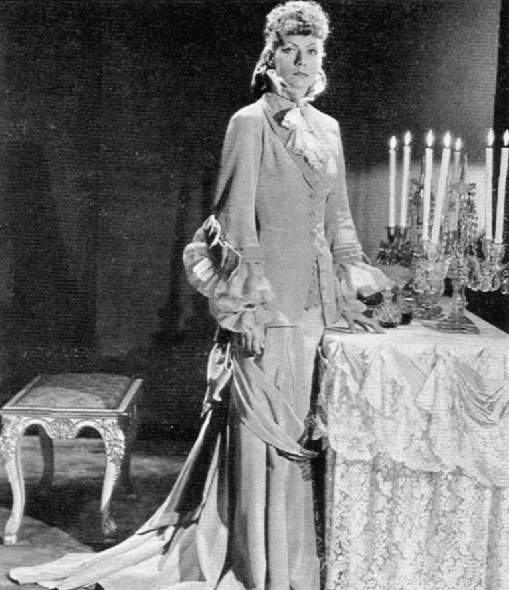
She kept having moments of doubt whether the carriage was moving forwards or backwards, or standing still. Was that Annushka beside her, or some stranger? ‘What is that on the armrest – a fur coat or some animal? And what am I? Myself or someone else?'
-Anna Karenina

Photo: Greta Garbo in the movie version, 1939

Saturday, April 23, 2011

Not Quite a Believer

Zoe Heller's The Believers, published two years ago to general critical acclaim, handles, one character at a time, the unraveling of the insufferable Litvinof family – a privileged clan of supposedly radical leftists luxuriously ensconced in a Greenwich Village townhouse.

The characters subject us to various intensities of annoyance. At the top of the heap in this regard is the clan's mother and the novel's central protagonist, Audrey.

Audrey is the least tolerable kind of leftist: theoretically in a fight for “the people” while simultaneously preoccupied with her own greatness – the cleaner does not show her enough deference, in her opinion; she daydreams of her husband's luxurious, star-studded funeral; she pretends money means nothing to her but resents those who have more. There is nothing to like about Audrey. She's mean to her daughters, she's borderline cruel to her best friend. Worse, the reader is left ignorant about why she's so unlikeable until page 190 (this excerpt is long, but necessarily so):

Once upon a time, her brash manner had been a mere posture – a convenient and amusing way for an insecure teenage bride, newly arrived in America, to disguise her crippling shyness. People had actually enjoyed her vituperation back then …

But somewhere along the way, when she hadn't been paying attention, her temper had ceased to be a beguiling party act that could be switched on and off at will. It had begun to express authentic resentments: boredom with motherhood, fury at her husband's philandering, despair at the pettiness of her domestic fate. She hadn't noticed the change at first. Like an old lady who persists in wearing the Jungle Red lipstick of her glory days, she had gone on for a long time, fondly believing that the stratagems of her youth were just as appealing as they'd every been. By the time she woke up and discovered that people had taken to making faces at her behind her back – that she was no longer a sexy young woman with a charmingly short fuse but middle-aged termagant – it was too late. Her anger had become a part of her.


It's a good passage. Unfortunately, it's the only one in the book your really need to read on the topic of Audrey. You've now got Audrey nailed.


And even given this explanation, Audrey's character remains unjustifiably rude, mean-spirited, curmudgeonly. You don't want to read a book about a person like this (or at least I didn't), you want to put her in her place, show her how entirely useless she is by ignoring her, which you can't do if you keep reading. It's hard to get into a book when really you just wish the protagonist would go away.

I realize that this begs a certain question about whether characters have to be likable in order for a book to be good. And obviously, the answer is no. Despicable protagonists in great novels abound: Humbert Humbert (Lolita), John Self (Money), Alexander Portnoy (Portnoy's Complaint). Even Jay Gatsby is not exactly likable.

A literary device (or several) must exist, then, that takes an unlikable human and makes him or her compelling. The contenders:

Satire: Satire has always been a tenuous concept for me; when I think about it for too long, I stop understanding what it means or being able to know it when I see it. For reference's sake, satire is:

A literary composition, in verse or prose, in which human folly and vice are held up to scorn, derision, or ridicule.

Which seems oversimplistic to me. Satire, I think, is a portrayal of someone or someplace in a way that exposes its flaws. And the best satire exposes this by being true to human nature. But it has to be a well-rounded portrayal -- simply holding up human folly and vice to scorn, derision or ridicule is not enough. Many political analysts do that every day, but it ain't satire.

So if a portrayal of an unlikable person achieves satire, we applaud it because we are in cahoots with the author in exposing some ridiculous trait of the human condition, and therefore, we find the character not only tolerable but entertaining. The Believers was called satire by many a reviewer, but I'm not quite following that logic.

Show Don't Tell, Duh: If Heller had shown us the root of Audrey's sour temperament rather than told us outright in one self-contained passage, we might have been able to relate to it. We've all had a bad day, succumbed unjustifiably to a grotesque mood, taken it out on a stranger or on the person closest to us. This is Audrey's entire life, yes, but there is a trickle of her life in ours, and had her perspective been better laid out, we may have found ourselves more prone to view her life through it.

Empathy: Could it be that those authors listed above – Amis, Nabokov, etc. – had an ego-driven empathy for their characters, while Heller has no sympathy for this tyrant of a woman she has created? And empathy from an author is necessary to produce empathy in the reader? Heller remains detached from her characters throughout, which causes us to remain detached from them throughout. If we are to like unlikeable characters, we need to be brought a whole lot closer to them.


Anyway, I didn't dislike this book as much as the above review likely suggests. But I didn't actively like it either. Yes, this is a pretty basic third-grade level analysis (“I liked the part where ...”), but it explains where The Believers falls on the love-hate spectrum. Didn't dislike it enough to throw in the towel, but wasn't driven to plow through it either, and I think that has something to do with the points outlined above.

*Interior shot above is Uma Thurman's former dining room. That seemed relevant.

Friday, April 1, 2011

Richard Price Nails the Mixologist


I don't even know what garter sleeves are, but they have the right ring to them, in this best-ever description of a 'mixologist' from Richard Price's Lush Life, which I am currently tearing through as if some long lost love were waiting for me on the last page:

The baby-faced bartender-proprietor, Josh, like a twelve-year-old in dress-up, sporting garter sleeves and suspendered pants, hair bowl-cut and pomade-parted, but as earnest as a Kinsey researcher, every drink chin-pondered before acted upon ...
The scene unfolds from here inside (and in the back alley of) a clear approximation of the bar Milk & Honey. I am adoring this book.

Wednesday, March 30, 2011

If One Person Agrees with Me, I'm Right

Bobbed through waves of gratification today as I discovered someone who shares my sentiment about Denis Johnson: Jesus’ Son? Emphatic Yay. Tree of Smoke? Soporific Nay.

It’s just like when that lone spirit agreed with me the other night at Verlaine that Elizabeth Taylor was never really that amazingly pretty. Two adherents make it a fact!

At last, I am vindicated, on both counts.

(Seriously, this looks like my mom’s third-best friend’s junior prom picture):


Denis Johnson: Jesus' Son (Asylum)

Tuesday, March 1, 2011

Infinite Jest, Take One

The first page of the first (miraculously hand-written, on notebook paper!) draft of David Foster Wallace's Infinite Jest:


Via The Atlantic's Tumblr (which concept confuses me).

Monday, February 21, 2011

The Epigrammatic Novel vs. The Cumulative Novel

The novels I love fall into two general categories. More on my personal disposition in a minute, but first, the definitions:

The Epigrammatic Novel
When you open this type of novel up, the most brilliant lines intermittently tumble out and slam into you; the kind of lines that stand on their own as small manifestations of insight or illumination, even as they commingle with the larger story to create a larger and great piece of work. Lines like these:

Rosemary felt that this swim would become the typical one of her life, the one that would always pop up in her memory at the mention of swimming. –Fitzgerald's Tender is the Night.

All existence seemed to beat with a lower pulse than her own. -George Eliot's Middlemarch

“It is not only to heaven that we owe our virtues, but to timidity also…” -Machado de Assis' Dom Casmurro

Was that the beginning, that evening – on the dock at Avilion, with the fireworks dazzling the sky? It’s hard to know. Beginnings are sudden, but also insidious. They creep up on you sideways, they keep to the shadows, they lurk unrecognized. Then later, they spring. -Margaret Atwood's The Blind Assassin

“Her heart – if this makes sense – has always resided in the left side of her brain.” –Zadie Smith's On Beauty

I should be clear that the epigrammatic novel only works if the story and prose surrounding the epigrams rise to their level of distinction. The epigrams would not shine without the weight of the surrounding novel, and likewise, the novel would wilt clumsily without the contained epigrams.

The Cumulative Novel
The other kind of novel in my life is of a more subtle variety. You start reading a cumulative novel, and nothing particularly blows you away in the beginning, but it's an enjoyable read, and the pace is adequate, and it's technically well-written. It's only 100 or so pages in that you realize with a start how well-written. The cumulative novel accrues its greatness, rather than punching it at you by fits and starts. Such novels as The Fortress of Solitude, The Prime of Miss Jean Brodie. Pamuk's The Museum of Innocence, and Robbe-Grillet's Jealousy immediately come to mind as archetypes of the cumulative novel.


When I first started reading novels, and I mean really reading them, feverishly and relentlessly, in college, it was the epigrammatic novel that gripped me. That one could be advancing through the pages in a rather docile way, riding along comfortably on the plot, and then be suddenly stopped cold by a sentence that verbalized something heretofore ineffable in one's core – nothing was ever quite the same again after that started happening to me.

Saturday, February 12, 2011

In Which Miss Jean Brodie Leads Me to a Once-Famous Singer Named Oliver

Reading Muriel Spark's The Prime of Miss Jean Brodie, my pervading reaction for the first 80 or so pages was that if ever there was a novel tailor made for film adaptation, this was it. The plot follows a teacher (Miss Brodie) at a respected girls school in Edinburgh in her relationship with the six students she has chosen as “the Brodie set.” It is the 1930s and an unmarried woman in her forties struggles to define herself as something beyond a “spinster.” Miss Brodie succeeds, and she doesn't. Meanwhile, her chosen ones absorb her influence, to varying effects. In the end, one of them betrays her, and that betrayal is not sentimentalized.

It's the anti-Dead Poet's Society. With girls! It could be the quality alternative to Mona Lisa Smile. It could be a film in which progressive women born at the wrong time meet with disappointment and ultimate defeat, instead of tear-filled redemption, despite their perceived wit and determination.

I was picturing Rachel Weisz in the title role, and a herd of Dakota Fanning understudies for the Brodie set. I hadn't yet discovered that it had already been done; just once, in 1969 and with Maggie Smith in the role of Jean Brodie.


Smith won an Oscar for her performance. The film garnered one other Academy Award, for best song, which is where my analysis of Miss Brodie makes a permanent digression. The song, like all songs, is on Youtube. It's called “Jean,” and it's pretty terrible:


The singer of “Jean” was known as Oliver. He was, for probably not nearly long enough if you asked him, a famous entertainer. This, his second single, reached number two on the Billboard pop chart. Oliver performed on Ed Sullivan. He sold a million records. But then, his followup efforts were unable to duplicate his early successes.


People who were once famous are fantastically eerie. They are living ghosts: a shell of a one-time celebrity roaming the earth in the guise of an everyman. Oliver (real name William Swofford) became a real estate agent in Louisiana, and then a manager in a pharmaceutical company. He died of cancer in 2000, at the age of 54. Even Google doesn't seem to know much else about him.

It feels unnatural for fame to bear such little permanence. It seems like it ought to be a thing that, once achieved, cannot be taken away, like a college degree, or self-respect. Jean Brodie, I think, would not approve.

Saturday, January 29, 2011

Consider the Bookshelf

Someone very close to me has an issue with bookshelves. He says they are more or less ostentatious. People have bookshelves, he says, to boast of their faithfulness to a certain brow (most probably middle to high), or a certain intellectual temperament. There is no practical reason, he says, to keep all those books after they have been read. To do so is to show off.

These opinions were relayed to me as we sat at a party in the Midtown apartment of a friend of a friend's dead aunt, the kind of apartment that 50 years ago would have been considered avant-garde, in its way, and the kind of apartment that has not been touched in any significant way in the five decades since then. It was a time capsule, and we sat on a prim sofa with a wooden frame and velvet upholstery and we stared ahead at the floor-to-ceiling bookshelves and we understood that the dead aunt was an intellectual. Or, that she had wanted people to think she was one.

In an unrelated event, this person's outlook was backed up by a coworker last week, during an editorial meeting in which he used bookshelves as an analogy to social networking: “It's like how people used to have bookshelves filled with books to display their personalities. But now the Facebook page fills that role,” he said. It's less condemning, but it supports the contention that bookshelves are for something besides storing books; they are for show.

Well, I proudly have four bookshelves in my apartment, and I love them all. I am not alone. Bookshelf Porn, which already had 34,000 likes on Facebook by the time I found it, is filled with hypnotizing images like this:


Saturday, January 22, 2011

Novels I Didn't Finish: The Golden Notebook

I was drawn to purchase Doris Lessing's magnum opus The Golden Notebook not by her Nobel Prize win in 2007, but by the simple, revolting, enthralling fact of her having abandoned her children.

A junket through the key and less key figures of the incipient feminist/emancipation movement produces any number of women who resented their traditional family lives, and women who avoided traditional family lives altogether, and women who steered their families away from the traditional family life. But total abandonment by a mother remained beyond the pale. It contradicts every human notion we have of the infallible maternal instinct. It turns out that we, as a species, still look to the mother-child bond as a core tenet of humanity. My own mother once told me that the love mothers have for their children is the only thing that gives her any hope for the human race. That's some high praise, and it brings about a thick burden.

Still, as much as most of us feel sure that we would never do such a thing as abandon our own children, those same of us probably feel some sort of fascination with the woman who is capable of such; a woman who, like many famous men, answered to her self-imposed higher calling; a woman who felt in her deepest core that she had more important things to do.

And so, The Golden Notebook. It covers the kind of material that makes Nobel committees drool: communism, feminism, war, colonialism; the commingling of these Major Themes in a seminal era of Western culture. Unfortunately, the novel, or at least the first 159 pages of it, only sporadically lifted me out of boredom. Lessing writes with authority; she also writes in a monotone. The author herself often seems ambivalent about her product. Like she's been so austere in her ruminations for so long, she's forgotten how to laugh, and knows it.

It's a commonly expressed assumption that great literature, or great art of any kind, transcends its time. The Golden Notebook does not accomplish this feat. It is so earnestly and self-seriously of its time, there's no room for appropriation by future readers. The sense is that you would have had to have lived what Lessing lived, to some degree, in order to become hypnotized by the novel. You have to still take all of those Nobel-friendly topics very seriously yourself. I see how, at the time of its publication, it must have felt boldly relevant to certain women who were looking to find alliances in their rebellion against existing cultural norms. But to a woman who came of age decades later, it's more of a historical document.

Nevertheless, there were a few passages that got me excited. Here they are:

She was a tallish woman, and big-boned, but she appeared slight, and even boyish. This was because of how she did her hair... -p. 9

Our jokes, outside the formal meetings, were contrary to what we said, and thought we believed in. It is from that period of my life that I know how to watch the jokes people make. A slightly malicious tone, a cynical edge to a voice, can have developed inside ten years into a cancer that has destroyed a whole personality. -p. 65

There is a type of mind, like Willi's, that can only accept ideas if they are put in the language he would use himself. -p. 87

At that time of my life, for reasons I didn't understand until later, I didn't let myself by chosen by men who really wanted me. -p. 110

Tuesday, January 18, 2011

Writers Who "Had" to Be Writers


I think sometimes about what compels me to write. There is a selfless element to it -- to find commonality with others, to write something that others will read and accordingly relate to you with. But ultimately it's mostly a selfish act: I would like to invade your world with my thoughts, and I would like to showcase my mind in the best possible light. And writing, for me, is the medium of least resistance with which to accomplish this.

That desire comes as a surprise to me, being a relatively private person. It runs counter to, for example, my commitment to never crying until I am alone, or my propensity to brush over a fervid bad mood during a glass of wine with a close friend, choosing instead to feign good cheer. Writing feels like a far more natural way of processing those more penetrating thoughts or feelings. The most natural way, in fact.

So, I suppose, I have no problem saying that I need to write, or that I couldn't not write. But that, very fundamentally, is not at all the same as what the following writers have to say:

"I didn't have any proper education or qualifications, so I had to be a writer. What else would I have done?" -Doris Lessing

"I never wanted to do anything else, wouldn't be able to do anything else: it chose me." -Christopher Hitchens

"I was an only child who was never really good at anything else. I had no other option. I could write; I wanted to write; I wrote. Otherwise, I was unemployable." -Susan Hill

For better or worse, writing is what I do, it's what I do best. I'm not good for anything else." -Paul Auster

Anyone of middling or better intelligence, including the four individuals quoted above (and the countless other writers who have made similar statements), provided with the need, would find himself quite capable of being an office manager, say, or a truck driver, or a doorman, or a real estate agent.

What they are really saying is not that they lack the capacity for this kind of work, but that they are above it; they are above pedestrian occupations. Their statements reek of false modesty (and/or, privileged naivete). Because really, most likely, they have never been tested.

And then there is their opposite: I find the biography of Kafka depressing, because he never got the chance to bask in whatever literary stardom he deserved. (Kafka made a career as an insurance salesman, writing at night, alone in his room, never even trying to get published.) But in the context of the above statements, I find that I prefer his approach, and find it far less affected. Of the five, Kafka is the only one who proved that he had no choice but to be a writer. Those other writers merely fell into an existence that allowed them to pretend it.

Sunday, January 9, 2011

52nd and Lex: Marilyn on the Subway Grate, Portnoy Meets the Monkey

Two things, one (nominally) real and one fictional, happened on the same corner, 52nd Street and Lexington Avenue:

Portnoy meets The Monkey (in Philip Roth's Portnoy's Complaint):


Marilyn stands over a subway grate (image taken from this week's NY Times article):


Thursday, December 30, 2010

Novels I Should Have Read Decades Ago: Catch-22

Without necessarily knowing the specifics, most Americans know a catch-22 when they see one -- it was a phenomenon badly in need a name, once. The Germans probably already had one, but for us, a novel had to come around and do the job.

Catch-22 is, essentially, a one-trick pony of a book, and a long one at that. What makes it work is that the trick never seems to get old. The prototype catch-22 dictates that all pilots in World War II would have to be crazy in order to continue flying missions, but if one asked to be “grounded,” he is thus proven sane, because no one in his right mind would agree to fly more missions, and the military needs him flying missions all the more, because he is one of the only sane ones. More succinctly, with either available choice, one is screwed. The novel’s principle victim of catch-22 is Yossarian, a pilot whose required number of missions is raised every time he completes the formerly required amount.

Some might call this novel plotless, which on a macro-level it mostly is. But it’s packed tight with smaller stories, hardly more than anecdotes, that alternately expose wartime absurdities, human absurdities, capitalist absurdities, and less easily classifiable absurdities. A major named Major is denied meals and other services because he did not sign a “loyalty oath.” However, the loyalty oath was created by a vindictive peer with the express intent of denying Major Major an opportunity to sign it; at another point, Major Major, who dislikes dealing with people, makes the decision to allow callers into his office only when he is not there. Visitors can wait to see him, but they won't be allowed in until he is gone; another catch-22: A girl Yossarian falls in love with and sleeps with in Rome refuses to marry him because he's crazy. How does she know? Because only a crazy man would marry a women who's not a virgin. (I am discovering that another trait of the catch-22 is that it is nearly impossible to summarize using few words.)

Wednesday, August 18, 2010

The Newest Great American Novelist


"He's not the richest or most famous."
Probably the whitest and most male, though.

The phrase comprising the headline at left doesn't really ever get used in reference to any other combination of physical traits. It's what's expected of that phrase, still today.

The Corrections was mostly worthy of the praise it received, though, even if this bit, from the Time cover story, is a bit much:
"His third book, The Corrections, published in 2001, was the literary phenomenon of the decade."

Roberto Bolano may or may not be rolling in his grave in response. Dave Eggers is likely chuckling at the irony of such a statement. Zadie Smith is just happy they're leaving her alone. All the other Jonathans are trying to get a word in edgewise. Etcetera.

Still, nice to see a novelist on a magazine cover. Only 15 authors have ever graced the cover of Time (which each occurrence one time would have meant something to the zeitgeist). Bold Type made a slideshow documenting them all, from early illustrations through to the grey, somber, genius-burdened photograph featured in this post.

Monday, September 28, 2009

Review of The Anthologist, by Nicholson Baker

The lover of literature in America today does not read poetry. For her, poetry’s day is long past, as is the short story’s, to a lesser degree. The novel is and has been king for a century or so. It is thus an obliquely brilliant idea, if your aim is to incite the reading public to consider poetry, to do so through the prose of a novel. Which is exactly what Nicholson Baker accomplishes in his new novel, The Anthologist.


Baker’s narrator/protagonist, Paul Chowder, does not generally write prose. He is a poet who has been tapped to assemble an anthology of rhyming poetry; he has to write the (prose) introduction, and he can’t, so he writes this prose novel instead, which makes as its principle topic a thorough dissection and analysis of…poetry.


The very premise is a contradiction – a man with writer’s block ought not be able to write an entire novel. (If only procrastination took people toward novel-writing, rather that away from it!) And yet it mostly works. Although, the “mostly” in that sentence is not a throwaway word. What works in The Anthologist is lovely, but what doesn’t threatens the whole enterprise.


Paul’s live-in girlfriend has just left him, the last straw for her being his inability/refusal to write the anthology’s introduction. Like in Baker’s other novels, the plot is slight. Chowder mows the lawn, Chowder cleans out his office, Chowder cuts his finger, Chowder observes the mouse in his kitchen, Chowder misses his ex. The most important plot points are negatives; they are things he is not doing. He is not writing the introduction, he is not writing poetry, he is not making money. The only proactive plot point, if it can qualify as such, is his preoccupation with the history and state of poetry.


To put it mildly, the man is obsessed. His life, to his mind, “is necessary because I sustain the idea of poetry through thick and thin.” Consider that he “drove to Portland listening to a CD of Elizabeth Bishop reading ‘The Fish.’ Cried, beating the steering wheel because she was so good and sounded so young,” and you realize he means it.


One wonders if it would be possible to find one person in all of America as obsessed with poetry as is Paul Chowder, and then forgets this line of criticism because she hopes that the answer is yes. Still, basing a contemporary prose novel on poetry is a risky move. Baker undoubtedly understands his audience well enough to know that poetry probably isn’t its thing. Most of his audience has probably read Wasteland and The Second Coming and a few others in some college seminar once, and not much else. Come to think of it, Chowder’s poetic reflections are not unlike a particularly compelling poetry seminar:


Auden says: “About suffering, they were never wrong, the eld masters.” He has a pronounced Oxford accent. The poem actually rhymes, but subtly. One line ends “Forgot,” and then there’s “untidy spot.” It’s such a famous poem I almost hesistate to bring it up. But I do hope you will read it.


The famous part of the poem is about Breughel’s Icarus. About the fact that there’s a whole painting of a seaport…But if you listen to Auden read it, you can’t skip ahead to the Icarus part, and you realize that a lot of the poem isn’t about that painting. It’s about the torturer’s horse, and about how the “dogs go on with their doggy life.” Nobody ever put that way of talking in a poem before. That the Christopher Isherwood note. “The dogs go on with their doggy life/ And the tortuter’s horse scratches its innocent behind on a tree.” When Auden reads it, that’s what you remember. You can hear his own amazement that he had been capable of that simply, completely new bit of poetic speech. Chistopher Isherwood was a huge influence on Auden. That’s what people don’t understand. Isherwood is partly responsible for Auden’s greatness. When they went their separate ways, Auden’s poetry grew colder and more abstract. Isherwood was the wax on Auden’s wings.


His countless musings on the pros and cons of rhyming versus not succeed in engaging the prose reader, as well. As do the breakdowns of iambic pentameter and quadruplets and meter. In its way, it the most fun history of poetry one could hope for. (Only the bit where he attempts to explain the human mind’s affinity for rhyme fails to entertain or enlighten.)


That’s the good stuff, which is from time to time interrupted by the falsely naïve observations Chowder sets forth about his own life or his own writing process:


What I’m trying to do when I’m writing poetry is I’m trying to make a little side salad. Just the right amount of sprouts on top, maybe a chickpea or two. No bacon. Maybe a slice of egg.

Or:

Wow, it’s fantastic. Meals on Wheels chicken. Fantastically good. Fleshy as hell, though. The flight muscles of a bird. Think of it. Wash it down with a little milk, strange as that may seem. Mmm. Excuse me.

A serious poet should never be so cutesy, not even when he’s not being serious. The novel contains so many great lines and almost as many great ideas and digressions, one regrets being distracted by the cuteness all the more. Add to this the tragically abrupt ending, which I’ll refrain from summarizing here to avoid spoilage, and you’ve got the totality of its flaws.


Which upon reflection, aren’t many.

Friday, March 20, 2009

Brief Thoughts on The Possiblity of an Island

A first impression of Michel Houellebecq’s novel, The Possibility of an Island, is that it is a French version of Martin Amis’ Money – A guy in show business is corrupted by it. He loves two different women. One of them, in a paraphrase of Houellebecq’s words, doesn’t like sex enough and the other doesn’t like love enough. Both novels are crass, both define the world through the male libido, both feature protagonists that aren’t well-liked and don’t want to be.


But where the unpleasant protagonist of Money is concerned with debauchery above all else, broken by only brief interludes of conscience and regret, The Possibility of an Island takes things in another direction: Its narrator’s twin obsessions with youth and aging form the foundation of his misanthropic approach to life. When his youth, and that of his partner, begin to fade, he feels that life is effectively over. And he wants it to be this way, because of his predicposition to find the hopelessness in humanity. He’s not exactly a fatalist – that would require a far more serene approach to his final love affair with a self-involved girl-woman 25 years his junior – but he does seem uninterested in looking for new sources of contentment once the buoyancy of sex wilts.


Most thinking people at one point or other agonize over life’s absurd ultimate pointlessness, but Daniel succumbs to the notion completely. A human, he says, “cannot be happy, and is in no way conceived for happiness, and his only possible destiny is to spread unhappiness around him by making other people’s existence as intolerable as his own…” He might be describing himself here, but he thinks he is describing all of humankind, which is a serious flaw. The novel seems to have no awareness of the narrator’s mistake. At any rate, it’s no wonder Daniel is so easily taken in by a cult that promises to make his future self something other than human.


Island is split into two parts, treated in alternating chapters. There is the one described above, and then there is the sci-fi portion, narrated by Daniel 24 and Daniel 25 – future versions of the original Daniel. In these chapters, human beings, through cloning, have evolved into a new species called neohumans. When the latest version of a person reaches a certain age, he or she voluntarily dies, making way for the next in line. Over time, neo-humans lost the traits that normally make us humans feel alive; things like love, learning, and adventure. They never have to grow old, but then who cares, when the eternal young no longer bother with sex? This is the novel’s essential conundrum.


What we take from the two parts of the novel is a double negative – it sucks to be human and it sucks to be deprived of the things that make us human. There is no happiness in old age; to be more specific, there is no happiness outside of sex, which cannot be attained in the same way in old age that it can in youth. Houellebecq is a talented writer and there are passages in the novel that charm, in spite of themselves. But he never wanders very far from his scorn, and it’s hard to see where he’s going with that. As a result, he fails to rise above the ranking of rebel without a cause.