The Epigrammatic Novel
When you open this type of novel up, the most brilliant lines intermittently tumble out and slam into you; the kind of lines that stand on their own as small manifestations of insight or illumination, even as they commingle with the larger story to create a larger and great piece of work. Lines like these:
Rosemary felt that this swim would become the typical one of her life, the one that would always pop up in her memory at the mention of swimming. –Fitzgerald's Tender is the Night.
All existence seemed tobeat with a lower pulse than her own. -George Eliot's Middlemarch
“It is not only to heaven that we owe our virtues, but to timidity also…” -Machado de Assis' Dom Casmurro
Was that the beginning, that evening – on the dock at Avilion, with the fireworks dazzling the sky? It’s hard to know. Beginnings are sudden, but also insidious. They creep up on you sideways, they keep to the shadows, they lurk unrecognized. Then later, they spring. -Margaret Atwood's The Blind Assassin
“Her heart – if this makes sense – has always resided in the left side of her brain.” –Zadie Smith's On Beauty
I should be clear that the epigrammatic novel only works if the story and prose surrounding the epigrams rise to their level of distinction. The epigrams would not shine without the weight of the surrounding novel, and likewise, the novel would wilt clumsily without the contained epigrams.
The Cumulative Novel
The other kind of novel in my life is of a more subtle variety. You start reading a cumulative novel, and nothing particularly blows you away in the beginning, but it's an enj
 oyable read, and the pace is adequate, and it's technically well-written. It's only 100 or so pages in that you realize with a start how well-written. The cumulative novel accrues its greatness, rather than punching it at you by fits and starts. Such novels as The Fortress of Solitude, The Prime of Miss Jean Brodie. Pamuk's The Museum of Innocence, and Robbe-Grillet's Jealousy immediately come to mind as archetypes of the cumulative novel.
When I first started reading novels, and I mean really reading them, feverishly and relentlessly, in college, it was the epigrammatic novel that gripped me. That one could be advancing through the pages in a rather docile way, riding along comfortably on the plot, and then be suddenly stopped cold by a sentence that verbalized something heretofore ineffable in one's core – nothing was ever quite the same again after that started happening to me.
I'm sure that the first novel with which I experienced this phenomenon was The Age of Innocence, because it is about two people (pictured in the movie version below) whose most cherished sentiments lie in discord with the conventions of the world in which they find themselves living, and I had naively presumed I would feel the opposite of that
 way at the Big Ten school I attended, until I got there, at which time I nearly immediately began biding my time until I could escape the Midwest altogether for a more amenable environment.
I know, it's not a unique story; it may even qualify as a cliché. But when you are 19 and it is happening to you, it is momentous and earth-shattering and it charts the course of your life, and it certainly doesn't feel like you are following in anyone's footsteps as it does so. The Age of Innocence, and then a frantic slew of novels after it, gave legitimacy to my restlessness like nothing else I experienced during that period. And it was, as those others that followed it, a wonderfully epigrammatic work. For example:
-In consequence of his search he arrived late at the office, perceived that his doing so made no difference whatever to anyone, and was filled with sudden exasperation at the elaborate futility of his life.
-Archer, who dressed in the evening because he thought it cleaner and more comfortable to do so ... never stopped to consider that cleanliness and comfort are two of the costliest items in a modest budget.
-"You like so much to be alone?"
"Yes, as long as my friends keep me from being lonely."
-A lady who knew how to thanks all-powerful elderly gentlemen to such good purpose for a bunch of flowers did not need either the private consolations or the public companionship of a young man of his small compass.
And so on.
I didn't warm to the cumulative novel until much later. This is probably a natural progression; in the beginning, a reader doesn't appreciate the nebulous inner workings of how thousands of words are strung together to become one cohesive statement, she only understands the force of a single ideation that kneads her gut. The epigrammatic novel is the obvious entry point into literature, in this way.
The best novels are both epigrammatic and cumulative, but even these tend to veer toward one or the other, for me. (The only exception that pops immediately to mind, the novel that is even parts each type, is War and Peace, for whatever that's worth.) The Age of Innocence is, though it leans more to the epigrammatic, a cumulative novel, as well. I didn't realize at the time that it amounted to a splendid cautionary tale, there to portray what happens if you let your decisions be dictated for you by an indolently cautious community. Taken as a whole, it provides a merciless and accurate critique of society. I didn't know at the time that I was also affected by this cumulative aspect of the novel, but I certainly was.
This isn't to say that I now favor the cumulative over the epigrammatic. I only mean to show the difference, and to illustrate how both can be vital to a reader, especially as that reader progresses through different eras of her life.
Images:
-"The Reader," by Jean-Honoré Fragonard, ca. 1770, National Gallery of Art, Washington D.C.
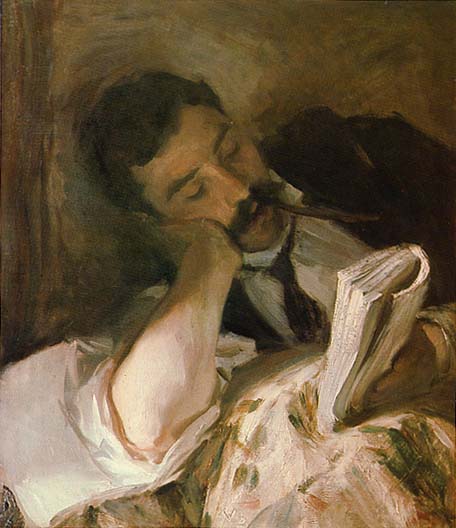
-"Man Reading," by John Singer Sargent (1856-1929), Reading (Pa.) Public Museum and Art Gallery.
-Still from The Age of Innocence, Directed by Martin Scorsese, 1993.

No comments:
Post a Comment