Friday, May 27, 2011

Better to be a Male Writer, Cats Edition

Thanks to the blog Writers and Kitties, we can now simultaneously view the most popular (G-rated) thing on the Internet alongside one of the least popular, the long-form writer:


If I were Werner Aspenstrom (above Swedish poet and essayist), or better, if I were me, but in possession of the stately cat in this photo, a re-creation of this photo featuring me, and a book deal, I know exactly what my author photo would look like. Except probably not, because I am a female and a woman with a cat is a cliche of plucky pitiable loneliness, while a man with a cat is awesome, the cat having singularly penetrated his manly inability to feel warmth.

To wit, no one is more endearing than Herman Hesse and his cat:


No one more badass than Bukowski and his:


And no one more just a lady with a cat than Lydia Davis and hers:


So, never mind; Werner, I guess you can keep your awesome manly-heart photo.

Friday, May 20, 2011

A Fish Called Sushi

This fish, in what he can only hope is not a cruel joke at the hands of Destiny, is named Sushi. In this photo, we have Sushi offering up to his owner, Erum, who just hours later will depart for a summer in Berlin, his best puppy-dog face. I think it kind of works for him.

Still, he watched sadly and helplessly as she walked out the door at 6:30 a.m. en route to JFK, and grasped for the first time what it is to feel happy and sad at the same time.

Sushi would shed a tear, if saltwater weren't so violently lethal to him, a mere goldfish that isn't even gold. Sushi will persevere, left behind in his tank, pacing or circling until fall arrives and returns Erum to him. Or you know, since he's a goldfish, maybe he won't.

Wednesday, May 18, 2011

Epitaph of a Small Winner, The Best Book You've Never Heard Of

That weasel Woody Allen – the piddlingest man ever to become a lady-killer – included Epitaph of a Small Winner on his list of five favorite all time books over at The Daily Beast, and I once again find myself applauding his artistic sensibilities in spite of his diminutive, incestuous, over-the-top Jewish neurotic tendencies (which explains the lady-killing, really). Epitaph of a Small Winner should be on more top five lists. It's on mine. And Susan Sontag wrote an ecstatic introduction to the English translation, so now you don't even have to take my and Woody's word for it.

Written by the 19th century Brazilian author Machado de Assis, the novel pops up from time to time in the general literary consciousness, enough to remain in print but hardly enough to be considered even a cult favorite.

I discovered it in much the same way as Allen – he stumbled upon it in his mailbox, I stumbled upon it in a used bookstore. Who knows what prompted me to buy it. I don't usually buy books that I have never ever heard of. It was probably the Sontag stamp of approval, if I'm being honest.

Unfortunately, Woody doesn't have much of use to say about the novel – “It's a very, very original piece of work.” Well, yes. It's also heartbreaking and cavalier at the same time, which most of my favorite things are and which I think is a real feat. Sontag summarizes the sentiment like this: “Epitaph of a Small Winner is probably one of those thrillingly original, radically skeptical books which will always impress readers with the force of a private discovery.”

By the way, it isn't really called Epitaph of a Small Winner. The direct translation is more like Posthumous Diaries of Braz Cubas. But I like Epitaph of a Small Winner better – in this case, the faulty outshines the precise. Like champagne! Sontag calls the English title “interfering,” but I still like it. It's okay to disagree with Susan Sontag! Champagne!

Monday, May 9, 2011

The Fact of Joan Didion's Fiction

Despite my longstanding, tenuously controlled obsession with Joan Didion, from which such things have been extracted as a passing interest in Los Angeles, photocopied essays thrust into the hands of unwitting acquaintances, and the title of this blog (callout to the only person who ever got the reference on his own), I never read any of her fiction until this past week, when I fluttered through Play It as It Lays.

It's a slight novel, about a woman for whom circumstance has made an impending nervous breakdown a credible option. She's married to a film producer, who took her from modeling in New York to occasional acting, but mostly lingering, in LA. It reminds me of the first pages of Fitzgerald's This Side of Paradise, where this happens:

From his fourth to his tenth year he did the country with his mother in her father’s private car, from Coronado, where his mother became so bored that she had a nervous breakdown in a fashionable hotel, down to Mexico City, where she took a mild, almost epidemic consumption.


At first, I was sure that the protagonist, Maria, was merely a standin for Didion herself, a woman who has maintained a decades-long, cerebrally antagonistic relationship with just, life. But by the final chapters, I knew she was writing about another kind of person, because when Didion writes about her own nervous breakdowns, they have historial weight to them – place and time matter, a lot – but Maria is simply adrift in a superficial milieu that she doesn't much consider, despite what the summary on the back cover says.

In my favorite Didion essays, like, for instance, “In the Islands,” she writes about places like the Royal Hawaiian Hotel via her own experience there, but also via the role it has played in society – the people that stayed there had lives “lived always on the streets where the largest trees grow.” (One of my all-time favorite Didionisms.) This class of people exist outside of the thrust and pull of the world's great events, enabled by their wealth, etc. This part of the essay is at least as important as Didion's first-person recollections, and it's the part that was missing from Play It as It Lays. And that's why, I'm fairly certain, she's a famous essayist more than a famous novelist.

Still, it's undeniably Joan Didion; the prose still makes one shake her head in awe and, along with those black-and-white photos of a small, glamorous, disaffected woman, wish for the 1000th time that she could be her.


Dog-eared passages:
From my mother I inherited my looks and a tendency to migraine. From my father I inherited an optimism which did not leave me until recently. -p.5

It came to her that in the scenario of her life this would be what was called an obligatory scene. -p.50

She pretended to herself that she was keeping the baby, the better to invite disappointment, court miscarriage. -p.63

Maria could never keep up her end of the dialogue with hairdressers. -p.120

Maria made a list of things she would never do. She would never: walk through the Sands or Caesar's alone after midnight. She would never: ball at a party, do S-M unless she wanted to, borrow furs from Abe Lipsey, deal. She would never: carry a Yorkshire in Beverly Hills. -p.136

Sunday, May 8, 2011

A Fur Coat or Some Animal ... Myself or Someone Else?


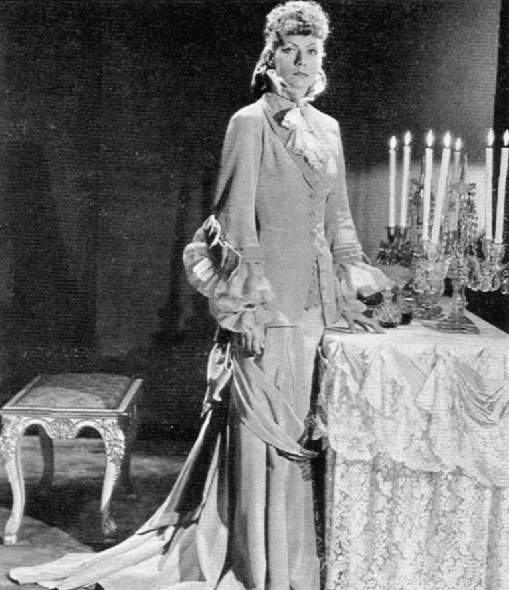
She kept having moments of doubt whether the carriage was moving forwards or backwards, or standing still. Was that Annushka beside her, or some stranger? ‘What is that on the armrest – a fur coat or some animal? And what am I? Myself or someone else?'
-Anna Karenina

Photo: Greta Garbo in the movie version, 1939

Wednesday, May 4, 2011

This Should Happen: Acting Awards for FNL's Vince

Michael B. Jordan, who plays star quarterback Vince on Friday Night Lights, deserves an Emmy/Golden Globe/Screen Actors Guild Award for his performance. Here's his Oscar-bait-money-clip from last week's episode, wherein he doesn't even talk until two minutes in and still manages to steal the scene:


He's just as good in the lighter moments, but I can't find a decent clip.