These opinions were relayed to me as we sat at a party in the Midtown apartment of a friend of a friend's dead aunt, the kind of apartment that 50 years ago would have been considered avant-garde, in its way, and the kind of apartment that has not been touched in any significant way in the five decades since then. It was a time capsule, and we sat on a prim sofa with a wooden frame and velvet upholstery and we stared ahead at the floor-to-ceiling bookshelves and we understood that the dead aunt was an intellectual. Or, that she had wanted people to think she was one.
In an unrelated event, this person's outlook was backed up by a coworker last week, during an editorial meeting in which he used bookshelves as an analogy to social networking: “It's like how people used to have bookshelves filled with books to display their personalities. But now the Facebook page fills that role,” he said. It's less condemning, but it supports the contention that bookshelves are for something besides storing books; they are for show.
Well, I proudly have four bookshelves in my apartment, and I love them all. I am not alone. Bookshelf Porn, which already had 34,000 likes on Facebook by the time I found it, is filled with hypnotizing images like this:

And this:
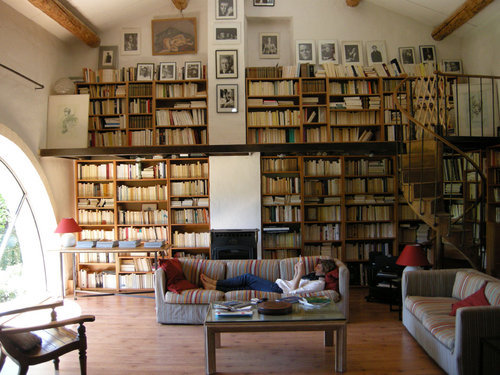
There is an attraction to bookshelves that transcends mere exhibition.
The great Steve Finbow said to me once, the first time I visited his home in London, a one-bedroom with bookshelves for walls, “I could never live in a flat without books.” Me either. And it's because my bookshelves, and Steve's, are not just for the benefit of visitors. There is a tangible connection between one's surroundings and one's disposition – think of your mood on a sunny, warm, breezy day, as opposed to, say, any day in the past month in New York. The phenomenon extends to indoor atmospheres: A cluttered apartment leads to cluttered thoughts. A stark apartment begets austerity. An historic apartment gives one a sense of cultural weight. An apartment with bookshelves inspires, for me, an air of calm, and of collective thoughtfulness. And I like to be thoughtful. It's too easy to forget to be. I like having something concrete to remind me what kind of life I want to maintain, it turns out.
I do not entirely dismiss those other explanations: Am I pleased that I can point to my copy of War and Peace and proclaim to have read it? Of course. Would I refuse to display anything from the genres of chick lit or self help? Of course again. Do I mind if someone comes to visit me, notices On Beauty tucked in there, comments on it, and sparks a conversation? I do not. To me, it's okay if someone gets a better idea of my interests by having a look around.
And anyway, you can't not choose a look for your living space. It's like fashion: You can't escape it, because you have to wear something. It's going to say something about you, no matter what you do. What it says may as well be accurate.
I realize that this fascination with books betrays the luddite in me. Entire bookshelves can now be contained in that woman on the subway's purse, because she has a Kindle. Just this week, Amazon announced that Kindle e-books now outsell the old-fashioned kind – we're past the halfway point toward obsolescence, it seems. Bookshelves may soon, just like that dead aunt's apartment, become a relic.
But until then, and probably still after, I will continue to feel quite certain that there isn't much I wouldn't do to be able to call this my own:


No comments:
Post a Comment