Sunday, May 8, 2011

A Fur Coat or Some Animal ... Myself or Someone Else?


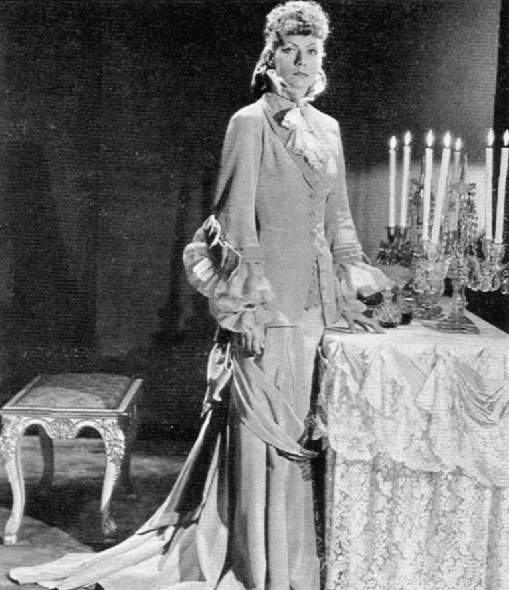
She kept having moments of doubt whether the carriage was moving forwards or backwards, or standing still. Was that Annushka beside her, or some stranger? ‘What is that on the armrest – a fur coat or some animal? And what am I? Myself or someone else?'
-Anna Karenina

Photo: Greta Garbo in the movie version, 1939

Wednesday, May 4, 2011

This Should Happen: Acting Awards for FNL's Vince

Michael B. Jordan, who plays star quarterback Vince on Friday Night Lights, deserves an Emmy/Golden Globe/Screen Actors Guild Award for his performance. Here's his Oscar-bait-money-clip from last week's episode, wherein he doesn't even talk until two minutes in and still manages to steal the scene:


He's just as good in the lighter moments, but I can't find a decent clip.

Friday, April 29, 2011

The People's Painting


Enlace, 2010
Painting bySpanish artist Juan Genoves.

Available at New York's Marlborough Gallery.

Tuesday, April 26, 2011

4 Thoughts I Directed at the TV Last Night

-There are Lost characters on every channel right now. This would have made a better ultimate plotline than that show's offensive finale. To wit (Hawaii 5-0, House, Modern Family, Mr. Sunshine):

-People never do tire of crime procedurals.

-Where's K-Fed?

-Every dress that T-mobile girl wears is amazing, and I don't even like pink. That somehow makes this an intelligent ad campaign:

Monday, April 25, 2011

New Madonna Book, Courtesy of Lots of People Including Me


An essay I wrote about Madonna's relationship with New York City will be included in the book, Madonna and Me, forthcoming from Soft Skull Press next year.

More news on this super exciting event as it super excitingly develops.

Saturday, April 23, 2011

Not Quite a Believer

Zoe Heller's The Believers, published two years ago to general critical acclaim, handles, one character at a time, the unraveling of the insufferable Litvinof family – a privileged clan of supposedly radical leftists luxuriously ensconced in a Greenwich Village townhouse.

The characters subject us to various intensities of annoyance. At the top of the heap in this regard is the clan's mother and the novel's central protagonist, Audrey.

Audrey is the least tolerable kind of leftist: theoretically in a fight for “the people” while simultaneously preoccupied with her own greatness – the cleaner does not show her enough deference, in her opinion; she daydreams of her husband's luxurious, star-studded funeral; she pretends money means nothing to her but resents those who have more. There is nothing to like about Audrey. She's mean to her daughters, she's borderline cruel to her best friend. Worse, the reader is left ignorant about why she's so unlikeable until page 190 (this excerpt is long, but necessarily so):

Once upon a time, her brash manner had been a mere posture – a convenient and amusing way for an insecure teenage bride, newly arrived in America, to disguise her crippling shyness. People had actually enjoyed her vituperation back then …

But somewhere along the way, when she hadn't been paying attention, her temper had ceased to be a beguiling party act that could be switched on and off at will. It had begun to express authentic resentments: boredom with motherhood, fury at her husband's philandering, despair at the pettiness of her domestic fate. She hadn't noticed the change at first. Like an old lady who persists in wearing the Jungle Red lipstick of her glory days, she had gone on for a long time, fondly believing that the stratagems of her youth were just as appealing as they'd every been. By the time she woke up and discovered that people had taken to making faces at her behind her back – that she was no longer a sexy young woman with a charmingly short fuse but middle-aged termagant – it was too late. Her anger had become a part of her.


It's a good passage. Unfortunately, it's the only one in the book your really need to read on the topic of Audrey. You've now got Audrey nailed.


And even given this explanation, Audrey's character remains unjustifiably rude, mean-spirited, curmudgeonly. You don't want to read a book about a person like this (or at least I didn't), you want to put her in her place, show her how entirely useless she is by ignoring her, which you can't do if you keep reading. It's hard to get into a book when really you just wish the protagonist would go away.

I realize that this begs a certain question about whether characters have to be likable in order for a book to be good. And obviously, the answer is no. Despicable protagonists in great novels abound: Humbert Humbert (Lolita), John Self (Money), Alexander Portnoy (Portnoy's Complaint). Even Jay Gatsby is not exactly likable.

A literary device (or several) must exist, then, that takes an unlikable human and makes him or her compelling. The contenders:

Satire: Satire has always been a tenuous concept for me; when I think about it for too long, I stop understanding what it means or being able to know it when I see it. For reference's sake, satire is:

A literary composition, in verse or prose, in which human folly and vice are held up to scorn, derision, or ridicule.

Which seems oversimplistic to me. Satire, I think, is a portrayal of someone or someplace in a way that exposes its flaws. And the best satire exposes this by being true to human nature. But it has to be a well-rounded portrayal -- simply holding up human folly and vice to scorn, derision or ridicule is not enough. Many political analysts do that every day, but it ain't satire.

So if a portrayal of an unlikable person achieves satire, we applaud it because we are in cahoots with the author in exposing some ridiculous trait of the human condition, and therefore, we find the character not only tolerable but entertaining. The Believers was called satire by many a reviewer, but I'm not quite following that logic.

Show Don't Tell, Duh: If Heller had shown us the root of Audrey's sour temperament rather than told us outright in one self-contained passage, we might have been able to relate to it. We've all had a bad day, succumbed unjustifiably to a grotesque mood, taken it out on a stranger or on the person closest to us. This is Audrey's entire life, yes, but there is a trickle of her life in ours, and had her perspective been better laid out, we may have found ourselves more prone to view her life through it.

Empathy: Could it be that those authors listed above – Amis, Nabokov, etc. – had an ego-driven empathy for their characters, while Heller has no sympathy for this tyrant of a woman she has created? And empathy from an author is necessary to produce empathy in the reader? Heller remains detached from her characters throughout, which causes us to remain detached from them throughout. If we are to like unlikeable characters, we need to be brought a whole lot closer to them.


Anyway, I didn't dislike this book as much as the above review likely suggests. But I didn't actively like it either. Yes, this is a pretty basic third-grade level analysis (“I liked the part where ...”), but it explains where The Believers falls on the love-hate spectrum. Didn't dislike it enough to throw in the towel, but wasn't driven to plow through it either, and I think that has something to do with the points outlined above.

*Interior shot above is Uma Thurman's former dining room. That seemed relevant.
Friday, April 15, 2011

The Lonely Photobooth

"Several Photo Booth Interiors (2005)," by Naomi Leibowitz.

You kind of forget that photo booths continue to exist when you and four drunk friends are not piled into them.

Discovered via Ocular Octopus.

Wednesday, April 13, 2011

If It Sounds Like Writing...

Some people get so lucky as to meet their literary heroes, and if they are even luckier, that hero utters a single sentence that, taken to heart, can meaningfully and permanently inform one's writing process. It's flash-mentoring, and apparently it happens in real life to other people.

Todd Zuniga's newish blog showcases such advice. It's a panacea for all of those with writer's block, ennui, or an internet connection (or, all of us, at some point). A couple of my favorites:

If it sounds like writing, rewrite it.

S. Patrick was told by Elmore Leonard

The best writing happens in the twenty minutes you DON’T get up for a cup of coffee.

Andrew O. Dugas was told by Ron Carlson


I keep hoping to send Todd my own nugget of appropriated writerly wisdom one day soon. But I have never met my favorite authors (with one notable exception -- and she did not want to bestow advice, she wanted me to disappear).

And then I am reminded of what I like to think of as my charming tendency to not ever remember the good advice I get anyway.

Thursday, April 7, 2011

The Blog's Influence on Writing

I am currently struggling with the third occurrence of a pattern that unfolds every time I start writing on the interweb again (outside of work, which is a different beast): starting out doing it just for me, just to have an outlet for the things that won't get published elsewhere. I do it anonymously. I don't show it to anyone.

Pretty soon, I decide that what I'm writing is good, and I'm a fool to not share it. (Don't you do that, trick yourself for a time into thinking that your approval of your own self is enough?) I dip my toe in. A Facebook share here; this time around, a Twitter post there. I even started a doppelganger tumblr, just to see what all the fuss is about. (Guys, I DO NOT GET TUMBLR.)

I start reading other blogs, to see what works and what doesn't, to cultivate ideas for my own writing, to get inspiration. But the opposite happens. The conclusion I come to, inevitably, invariably, tragically-for-me, is that the stuff that makes the internet putty in the hands of writers is the brassiest stuff; often good writing but always with a clever maneuver right out of the gate, because of how no one reads past the first couple of lines online unless there is a seriously entertaining hook, the more irreverent the better, yaddayaddayou'vehearditbefore.

In other words, a style other than the one I prefer. And then I get frustrated. Because none of this was what I meant for myself, but now I am feeling the pull of it. And I decide maybe I should quit the internet (again) and return my focus to writing the long-winded, fully formed thoughts that no one cares about anymore, maybe even including me.

Which more or less brings us up to my present state of mind, where I mope about convinced that I was born in the wrong era, the correct era having been the the era of the attention span. Which was, what, 1950-something? Or was it never, and I just remember a history I didn't live in the image that is most appealing to me?

I'm interested in hearing the thoughts of others on this. Did blogging change how you write? For better or worse? And how to you cope with the influence the blog exerts?

Tuesday, April 5, 2011

Cultural Confusion: Boobs Edition

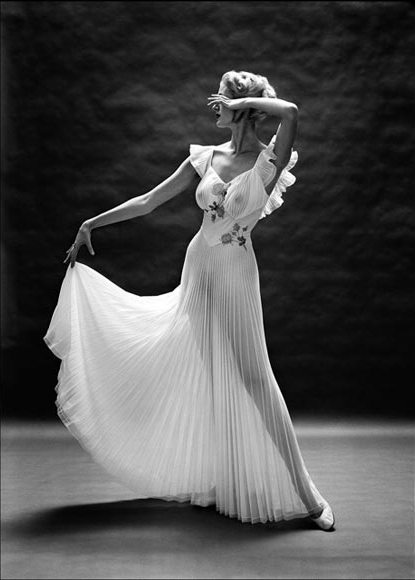
Because the model's face is strategically hidden in each of the photos in this 1953 series by Mark Shaw for Vanity Fair, focus shifts inexorably to the form, the elegance of which in this case arrests motion, in the kind of way where if you are raising a cup coffee to your lips you get it there but forget to sip.


As one's gaze moves from one photo to the next, a strange phenomenon begins to announce itself. Beneath the exquisitely choreographed ebbs of the gown, there are … breasts, on a model. And one realizes that it looks pretty fabulous, but it also looks unusual. Which in itself is unusual, being that breasts are not only natural but, more importantly, infinitely obsessed over by men and women both (although not alike).


Mostly today abundant cleavage only features in plus-sized ads and some swimwear spreads. I suppose it's been somewhat well-documented, the recent demise of the bosom in the fashion realm. This trend may be primarily a byproduct of Western culture's current obsession with extreme slimness: Breasts are fat, fat is bad in all its forms. Also, extreme dieting to attain extreme slimness tends to come at the expense of breasts.


There also has from time to time been mentioned an obsession with youth in our culture (although, this particular obsession is in some ways on the wane, a subject for another time). Breasts do not suggest extreme youth, but rather fully formed adulthood.

Friday, April 1, 2011

Richard Price Nails the Mixologist


I don't even know what garter sleeves are, but they have the right ring to them, in this best-ever description of a 'mixologist' from Richard Price's Lush Life, which I am currently tearing through as if some long lost love were waiting for me on the last page:

The baby-faced bartender-proprietor, Josh, like a twelve-year-old in dress-up, sporting garter sleeves and suspendered pants, hair bowl-cut and pomade-parted, but as earnest as a Kinsey researcher, every drink chin-pondered before acted upon ...
The scene unfolds from here inside (and in the back alley of) a clear approximation of the bar Milk & Honey. I am adoring this book.

Wednesday, March 30, 2011

If One Person Agrees with Me, I'm Right

Bobbed through waves of gratification today as I discovered someone who shares my sentiment about Denis Johnson: Jesus’ Son? Emphatic Yay. Tree of Smoke? Soporific Nay.

It’s just like when that lone spirit agreed with me the other night at Verlaine that Elizabeth Taylor was never really that amazingly pretty. Two adherents make it a fact!

At last, I am vindicated, on both counts.

(Seriously, this looks like my mom’s third-best friend’s junior prom picture):


Denis Johnson: Jesus' Son (Asylum)