
As one's gaze moves from one photo to the next, a strange phenomenon begins to announce itself. Beneath the exquisitely choreographed ebbs of the gown, there are … breasts, on a model. And one realizes that it looks pretty fabulous, but it also looks unusual. Which in itself is unusual, being that breasts are not only natural but, more importantly, infinitely obsessed over by men and women both (although not alike).
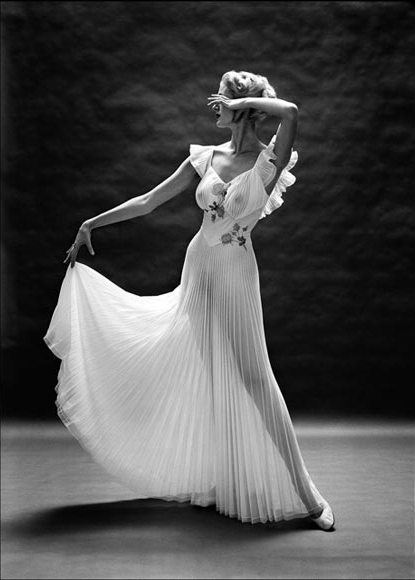
Mostly today abundant cleavage only features in plus-sized ads and some swimwear spreads. I suppose it's been somewhat well-documented, the recent demise of the bosom in the fashion realm. This trend may be primarily a byproduct of Western culture's current obsession with extreme slimness: Breasts are fat, fat is bad in all its forms. Also, extreme dieting to attain extreme slimness tends to come at the expense of breasts.

There also has from time to time been mentioned an obsession with youth in our culture (although, this particular obsession is in some ways on the wane, a subject for another time). Breasts do not suggest extreme youth, but rather fully formed adulthood.
Kate Moss, the original second-generation waif (first generation: Hepburn, Twiggy etc), actually expressed concern when she unexpectedly grew some boobs in her 30s: “My boyfriend might not like them. I’m a bit worried,” she told New York Magazine of her new B-cups.
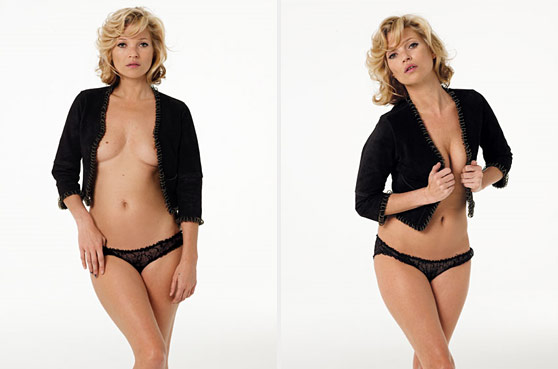
Yes, her poor boyfriend. Let's take a moment for him.
[...]
But all of this exists alongside the other extreme of breast size in our culture: the boob job. Perfectly attractive women commonly subject themselves to not-undangerous surgery in order to attain something exceeding the feminine ideal – this is not just double-A's endeavoring to achieve the norm. This is 34-B's sculpting themselves into caricature. And when the ideal is exceeded, as it so often is, it rarely creates a more-is-better scenario – it creates a Murakami sculpture:

The psychology behind this remains elusive. Is it a case of, having never had something that one covets, one overindulges in it when it finally comes available, like a straight-edge 25-year-old after his first beer? Is it a legitimate belief that a triple-D simply looks amazing on a frame that doesn't support it? Is it a cry for attention? Or is it a true psychosis, in the same neighborhood as anorexia, or full-body tattoos?
At any rate, the contrast between the typical high fashion photograph and the Heidi Montag school suggests a severe confusion in our culture regarding standards of beauty, especially considering that those people we are presumably trying to impress -- men -- prefer neither extreme (is my educated guess). In fact, I suspect that breasts are of interest to men just in that they exist, regardless of their size and shape, within reason. I don't think that any girl I know has ever been rejected because of her cup size. Perhaps I am wrong; perhaps there is a guy-world that I haven't infiltrated in which the correct breast size is a necessity on the path to a relationship. But I kind of doubt it. I have not noticed Kate Hudson, Debra Messing or Calista Flockhart struggling to get a date. Same goes for my flat-chested friends who shall remain nameless. At the same time, if given a choice, most men might probably choose something a little more substantial, up to the line at which that substance becomes cartoonish.
The reflection of the truth probably lies in the famous women that your guy friends most often proclaim their lust for: In my life, that list includes Scarlet Johansson, Halle Berry, Angelina Jolie and Penelope Cruz – all women who more closely resemble the woman in the Vanity Fair series than someone like Pamela Anderson, or most fashion models. (I provide exception for Giselle and the other Victoria's Secret models.)
The fact is, fashion photographs are taken of women, for women, their aesthetic shaped largely by females and gay males; straight men don't much look at them. So the question becomes, why have women and gay men led the fashionable ideal to a place in which a central feature of womanhood is removed from the picture?

As becomes obvious from looking at the Vanity Fair photos, that's a misguided move.
I have often heard the argument that, especially on runways, we want the models to be as unobtrusive as possible – if we could send hangers walking down the catwalk, we would. I don't quite buy it. And even if that were true of fashion shows – which in theory are mere trade shows for clothes – there is no easy explanation for the crossover to magazine pages.
The boob job is even more curious, because it mostly does not have a presence in mainstream culture. It's an outlier, but one that has infiltrated the preference of many, many otherwise well-adjusted people.
At the very least, we have on our hands a standard of beauty that has been skewed and manipulated and confused to the point where we don't even understand what we find attractive anymore. We have embraced two opposing extremes, when it's the middle ground that would seem to hold more inherent appeal.


1 comment:
What does velbenesque mean? Read it in a Joan didion piece and am a bit mystified . Led me to this thoughtfull piece - which I enjoyed very much
Post a Comment