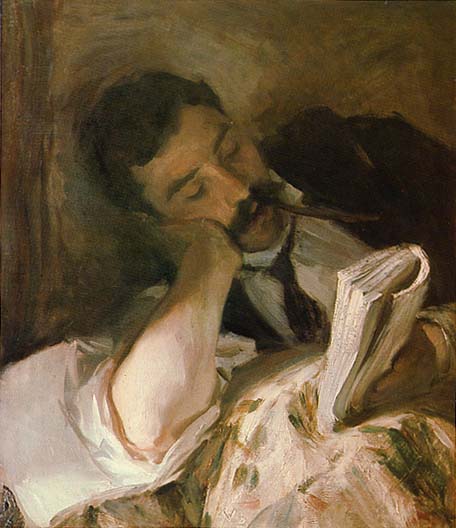
Your postmodern, western-culture disillusionment with the drone of the office is not postmodern, nor did it originate with advanced western culture. Nope: You, dear subordinate, are a cog in a very longstanding wheel:
Office work: a wearisome jumble; ink drafts: a crosshatch of deletions and smears. Racing the writing brush, no time to eat, sun slanting down but never a break; swamped and muddled in records and reports, head spinning till it’s senseless and numb— I leave off and go west of the wall, climb the height and let my eyes roam: square embankments hold back the clear water, wild ducks and geese at rest in the middle— Where can I get a pair of whirring wings so I can join you to bob on the waves?
From the newest issue of Lapham’s Quarterly, "Lines of Work."
Lest you think from the previous post that I spent my entire weekend strolling the Yale campus with my very smart friends, comparing copies of the Gutenberg Bible and indulging in superiority by association, I bring you the story of my Friday night in Danbury, Connecticut, population 80,000.
We drove up straight from work in Midtown to a gig at Cousin Larry's Cafe on Elm Street (not my gig. I am a mere groupie. And videographer). We got into town around 7:30, starving, and soon discovered at least two cavernous restaurants on Main Street in which no one on staff spoke a lick of English. The first one – Peruvian – also did not offer a lick of vegetarian fare, so we moved on to the Salvadorian joint and ordered far too many papusas.
Witness the interior of the Beinecke Rare Books & Manuscripts Library at Yale. The marble panels that constitute the walls are 1.25 inches thick. That's something like this: --------------------. Thin enough for light to filter through them and create a kaleidoscopic event.
Here are the same panels from the outside, from which vantage point they appear far more unfortunate:
If you are a person who finds humor in watching another person crash and burn – and if you touch your wrist and feel a pulse, you are – then trust me when I tell you to maintain your attention span until the end of this post.
In those halcyon days 10 months before there was an app for it, my friend Ray bought a pricey video camera with the primary function of re-creating the jerky nostalgia of super 8 film. Given that we live in an age when the most exciting thing a technologically unprecedented iPhone G9X can do is mimic old technology, some friends (Eric and Ellen, in addition to Ray) and I were entirely psyched to participate in a daylong re-creation of New York circa 1970. We were directed to meet in Williamsburg ("Hipsters will make good props"). It was the least cold Saturday of February 2010, so we bundled up and went for it.
We started in McCarren Park, cartwheeling and running and jumping our way through kickball games and Styrofoam margarita cups and girls walking side-by-side with their vintage bikes until, 75 percent of us having successfully pulled a muscle, we moved on, confident that our physical sacrifice bespoke of good things in the final product's future.
We wandered east, figuring that eventually this video would culminate at the river's edge. Somewhere on Berry Street, I think it was, we encountered two building-high murals, the contents of which were so kitschily patriotic, one can only suspect that they were made by someone for whom America was not always a foregone conclusion – on one wall, a sprawling American flag, on the other, its natural partner in crime, the bald eagle.
Ray thought it would be ironic and subversive if Eric gave me his flask of whiskey and I slugged some of it in front of the murals: very Don McLean meets Dazed and Confused meets, I dunno, James Dean. Swept up in his creative vision, I obliged. Walking with a cooked up bounce toward Eric's outstretched hand, I solemnly received the flask, turned on my heel, and returned to my assigned position.
We never finished Super 8 Project (the footage, it turned out, was nearly impossible to convert to editable form), but Ray's subsequent looping of the moment that followed, backed by a Bolero soundtrack, became a highlight of my year. If I'd made a top 10 list, this surely would have made the cut. I still refer to it regularly when in need of a laugh:
Next time you find yourself bewildered by humankind's capacity for war/violence/cruelty/psychosis, take a look at the kid in this photo. Further clarification probably won't be necessary:
The novels I love fall into two general categories. More on my personal disposition in a minute, but first, the definitions:
The Epigrammatic Novel When you open this type of novel up, the most brilliant lines intermittently tumble out and slam into you; the kind of lines that stand on their own as small manifestations of insight or illumination, even as they commingle with the larger story to create a larger and great piece of work. Lines like these:
Rosemary felt that this swim would become the typical one of her life, the one that would always pop up in her memory at the mention of swimming. –Fitzgerald's Tender is the Night.
All existence seemed to beat with a lower pulse than her own. -George Eliot's Middlemarch
“It is not only to heaven that we owe our virtues, but to timidity also…” -Machado de Assis' Dom Casmurro
Was that the beginning, that evening – on the dock at Avilion, with the fireworks dazzling the sky? It’s hard to know. Beginnings are sudden, but also insidious. They creep up on you sideways, they keep to the shadows, they lurk unrecognized. Then later, they spring. -Margaret Atwood's The Blind Assassin
“Her heart – if this makes sense – has always resided in the left side of her brain.” –Zadie Smith's On Beauty
I should be clear that the epigrammatic novel only works if the story and prose surrounding the epigrams rise to their level of distinction. The epigrams would not shine without the weight of the surrounding novel, and likewise, the novel would wilt clumsily without the contained epigrams.
The Cumulative Novel The other kind of novel in my life is of a more subtle variety. You start reading a cumulative novel, and nothing particularly blows you away in the beginning, but it's an enjoyable read, and the pace is adequate, and it's technically well-written. It's only 100 or so pages in that you realize with a start how well-written. The cumulative novel accrues its greatness, rather than punching it at you by fits and starts. Such novels as The Fortress of Solitude, The Prime of Miss Jean Brodie. Pamuk's The Museum of Innocence, and Robbe-Grillet's Jealousy immediately come to mind as archetypes of the cumulative novel.
When I first started reading novels, and I mean really reading them, feverishly and relentlessly, in college, it was the epigrammatic novel that gripped me. That one could be advancing through the pages in a rather docile way, riding along comfortably on the plot, and then be suddenly stopped cold by a sentence that verbalized something heretofore ineffable in one's core – nothing was ever quite the same again after that started happening to me.
Reading Muriel Spark's The Prime of Miss Jean Brodie, my pervading reaction for the first 80 or so pages was that if ever there was a novel tailor made for film adaptation, this was it. The plot follows a teacher (Miss Brodie) at a respected girls school in Edinburgh in her relationship with the six students she has chosen as “the Brodie set.” It is the 1930s and an unmarried woman in her forties struggles to define herself as something beyond a “spinster.” Miss Brodie succeeds, and she doesn't. Meanwhile, her chosen ones absorb her influence, to varying effects. In the end, one of them betrays her, and that betrayal is not sentimentalized.
It's the anti-Dead Poet's Society. With girls! It could be the quality alternative to Mona Lisa Smile. It could be a film in which progressive women born at the wrong time meet with disappointment and ultimate defeat, instead of tear-filled redemption, despite their perceived wit and determination.
I was picturing Rachel Weisz in the title role, and a herd of Dakota Fanning understudies for the Brodie set. I hadn't yet discovered that it had already been done; just once, in 1969 and with Maggie Smith in the role of Jean Brodie.
Smith won an Oscar for her performance. The film garnered one other Academy Award, for best song, which is where my analysis of Miss Brodie makes a permanent digression. The song, like all songs, is on Youtube. It's called “Jean,” and it's pretty terrible:
The singer of “Jean” was known as Oliver. He was, for probably not nearly long enough if you asked him, a famous entertainer. This, his second single, reached number two on the Billboard pop chart. Oliver performed on Ed Sullivan. He sold a million records. But then, his followup efforts were unable to duplicate his early successes.
People who were once famous are fantastically eerie. They are living ghosts: a shell of a one-time celebrity roaming the earth in the guise of an everyman. Oliver (real name William Swofford) became a real estate agent in Louisiana, and then a manager in a pharmaceutical company. He died of cancer in 2000, at the age of 54. Even Google doesn't seem to know much else about him.
It feels unnatural for fame to bear such little permanence. It seems like it ought to be a thing that, once achieved, cannot be taken away, like a college degree, or self-respect. Jean Brodie, I think, would not approve.
I'd never heard of Franz Xaver Messerschmidt until the Neue Gallery put on an exhibition of his work last year. The busts, collectively, depict the artist's notion that there are “64 canonical grimaces,” and the resulting expressions are priceless. See, The Yawn:
And, The Incapable Bassoonist:
And, The Difficult Secret:
The late 18th century, when these busts were made, was the time when emotions and passions made their way into the arts, but they generally did so in a more grotesque way, and mostly dealt in grand themes – death, war, the majesty of nature – and not in the everyday.
But the trove of history also contains a just a bit of screwball comedy, and makes barely enough room between the upheavals and catastrophes for the prosaic quirks that mark our less consequential days. Messerschmidt celebrates the little imperfections. Isn't it charming that we make the same goofy expressions today as they did 250 years ago? And, there was a healthy sense of the absurd in the 1700s – isn't that neat?
But alas, Messerschmidt is largely forgotten. It seems that, just like at the Oscars, humor, even when brilliant, doesn't stand a chance against the more agonizing themes.
This hereby linked-to essay examines the substance of elitism today. It is, like many an n+1 essay, trying to make several points all at once, resulting in a cacophony of erudition. I'll (potentially unwisely) try to boil it down as follows: Our understanding of elitism is confused. There’s both the “cultural elite” and the “power elite,” and both consist largely of old-school, closed-circuit networks, and both need to be rethought, but especially the cultural elite needs to be rethought, because it’s the one that should be running things, while as it stands now, it’s the power elite that’s running things. Or maybe the cultural elite just needs to be reinterpreted, not revamped. Or, the power elite needs to gain some respect for culture. Like I said, it’s an n+1 essay.
There are things to agree with here and things to disagree with. But I felt a particular whoosh of fundamental rightness as I read the following passage, about college:
Majoring in literature or art history rather than economics or biology, never mind hotel management or marketing, suggests a certain privileged indifference to material concerns (even when this rests on actual indifference instead of piles of money). And if you’ve gone into serious debt by attending college, afterward you’ll have noted that it’s the do-gooding NGO or the progressive magazine that expects you to take an unpaid internship, and the publishing house or academic department that offers you a pittance.
By the end of the next sentence, I nearly emitted a “you betcha,” my visceral sense of its accuracy had reached such great heights:
Goldman Sachs and Google, which pay real salaries, seem in this sense less addicted to exploitation, and more interested in income redistribution, than the Nation or the Yale English department.
It really flipped my notions of good and bad and right and wrong on their culturally elite heads.