Tuesday, February 22, 2011
Monday, February 21, 2011
The Epigrammatic Novel vs. The Cumulative Novel
The Epigrammatic Novel
When you open this type of novel up, the most brilliant lines intermittently tumble out and slam into you; the kind of lines that stand on their own as small manifestations of insight or illumination, even as they commingle with the larger story to create a larger and great piece of work. Lines like these:
Rosemary felt that this swim would become the typical one of her life, the one that would always pop up in her memory at the mention of swimming. –Fitzgerald's Tender is the Night.
All existence seemed tobeat with a lower pulse than her own. -George Eliot's Middlemarch
“It is not only to heaven that we owe our virtues, but to timidity also…” -Machado de Assis' Dom Casmurro
Was that the beginning, that evening – on the dock at Avilion, with the fireworks dazzling the sky? It’s hard to know. Beginnings are sudden, but also insidious. They creep up on you sideways, they keep to the shadows, they lurk unrecognized. Then later, they spring. -Margaret Atwood's The Blind Assassin
“Her heart – if this makes sense – has always resided in the left side of her brain.” –Zadie Smith's On Beauty
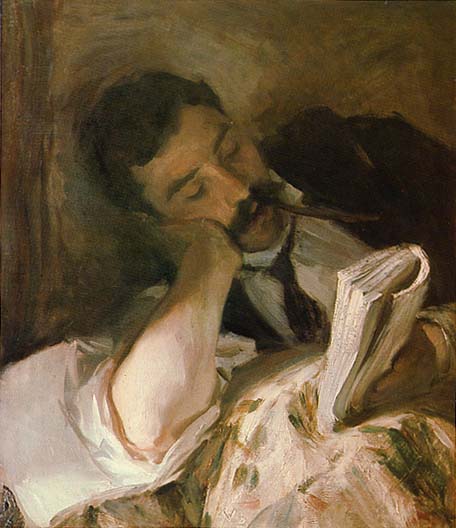
I should be clear that the epigrammatic novel only works if the story and prose surrounding the epigrams rise to their level of distinction. The epigrams would not shine without the weight of the surrounding novel, and likewise, the novel would wilt clumsily without the contained epigrams.
The Cumulative Novel
The other kind of novel in my life is of a more subtle variety. You start reading a cumulative novel, and nothing particularly blows you away in the beginning, but it's an enj
When I first started reading novels, and I mean really reading them, feverishly and relentlessly, in college, it was the epigrammatic novel that gripped me. That one could be advancing through the pages in a rather docile way, riding along comfortably on the plot, and then be suddenly stopped cold by a sentence that verbalized something heretofore ineffable in one's core – nothing was ever quite the same again after that started happening to me.
Friday, February 18, 2011
Liz Larner, "Blue on Green"

Yeah, that's rather beautiful.
Currently on view at the Tanya Bonakdar Gallery, 521 West 21st Street, NYC.
(Found via Art Fag City.)
Saturday, February 12, 2011
In Which Miss Jean Brodie Leads Me to a Once-Famous Singer Named Oliver
It's the anti-Dead Poet's Society. With girls! It could be the quality alternative to Mona Lisa Smile. It could be a film in which progressive women born at the wrong time meet with disappointment and ultimate defeat, instead of tear-filled redemption, despite their perceived wit and determination.
I was picturing Rachel Weisz in the title role, and a herd of Dakota Fanning understudies for the Brodie set. I hadn't yet discovered that it had already been done; just once, in 1969 and with Maggie Smith in the role of Jean Brodie.

Smith won an Oscar for her performance. The film garnered one other Academy Award, for best song, which is where my analysis of Miss Brodie makes a permanent digression. The song, like all songs, is on Youtube. It's called “Jean,” and it's pretty terrible:
The singer of “Jean” was known as Oliver. He was, for probably not nearly long enough if you asked him, a famous entertainer. This, his second single, reached number two on the Billboard pop chart. Oliver performed on Ed Sullivan. He sold a million records. But then, his followup efforts were unable to duplicate his early successes.

People who were once famous are fantastically eerie. They are living ghosts: a shell of a one-time celebrity roaming the earth in the guise of an everyman. Oliver (real name William Swofford) became a real estate agent in Louisiana, and then a manager in a pharmaceutical company. He died of cancer in 2000, at the age of 54. Even Google doesn't seem to know much else about him.
It feels unnatural for fame to bear such little permanence. It seems like it ought to be a thing that, once achieved, cannot be taken away, like a college degree, or self-respect. Jean Brodie, I think, would not approve.
Tuesday, February 8, 2011
The 64 Canonical Grimaces of Messerschmidt

And, The Incapable Bassoonist:

And, The Difficult Secret:
The late 18th century, when these busts were made, was the time when emotions and passions made their way into the arts, but they generally did so in a more grotesque way, and mostly dealt in grand themes – death, war, the majesty of nature – and not in the everyday.
But the trove of history also contains a just a bit of screwball comedy, and makes barely enough room between the upheavals and catastrophes for the prosaic quirks that mark our less consequential days. Messerschmidt celebrates the little imperfections. Isn't it charming that we make the same goofy expressions today as they did 250 years ago? And, there was a healthy sense of the absurd in the 1700s – isn't that neat?
But alas, Messerschmidt is largely forgotten. It seems that, just like at the Oscars, humor, even when brilliant, doesn't stand a chance against the more agonizing themes.
Tuesday, February 1, 2011
How Do You Prefer Your Elites?

This hereby linked-to essay examines the substance of elitism today. It is, like many an n+1 essay, trying to make several points all at once, resulting in a cacophony of erudition. I'll (potentially unwisely) try to boil it down as follows: Our understanding of elitism is confused. There’s both the “cultural elite” and the “power elite,” and both consist largely of old-school, closed-circuit networks, and both need to be rethought, but especially the cultural elite needs to be rethought, because it’s the one that should be running things, while as it stands now, it’s the power elite that’s running things. Or maybe the cultural elite just needs to be reinterpreted, not revamped. Or, the power elite needs to gain some respect for culture. Like I said, it’s an n+1 essay.
There are things to agree with here and things to disagree with. But I felt a particular whoosh of fundamental rightness as I read the following passage, about college:
Majoring in literature or art history rather than economics or biology, never mind hotel management or marketing, suggests a certain privileged indifference to material concerns (even when this rests on actual indifference instead of piles of money). And if you’ve gone into serious debt by attending college, afterward you’ll have noted that it’s the do-gooding NGO or the progressive magazine that expects you to take an unpaid internship, and the publishing house or academic department that offers you a pittance.
By the end of the next sentence, I nearly emitted a “you betcha,” my visceral sense of its accuracy had reached such great heights:
Goldman Sachs and Google, which pay real salaries, seem in this sense less addicted to exploitation, and more interested in income redistribution, than the Nation or the Yale English department.
It really flipped my notions of good and bad and right and wrong on their culturally elite heads.
Saturday, January 29, 2011
Consider the Bookshelf
These opinions were relayed to me as we sat at a party in the Midtown apartment of a friend of a friend's dead aunt, the kind of apartment that 50 years ago would have been considered avant-garde, in its way, and the kind of apartment that has not been touched in any significant way in the five decades since then. It was a time capsule, and we sat on a prim sofa with a wooden frame and velvet upholstery and we stared ahead at the floor-to-ceiling bookshelves and we understood that the dead aunt was an intellectual. Or, that she had wanted people to think she was one.
In an unrelated event, this person's outlook was backed up by a coworker last week, during an editorial meeting in which he used bookshelves as an analogy to social networking: “It's like how people used to have bookshelves filled with books to display their personalities. But now the Facebook page fills that role,” he said. It's less condemning, but it supports the contention that bookshelves are for something besides storing books; they are for show.
Well, I proudly have four bookshelves in my apartment, and I love them all. I am not alone. Bookshelf Porn, which already had 34,000 likes on Facebook by the time I found it, is filled with hypnotizing images like this:

Wednesday, January 26, 2011
Photo that Looks Like a Painting that Looks Like a Photo
Saturday, January 22, 2011
Novels I Didn't Finish: The Golden Notebook
A junket through the key and less key figures of the incipient feminist/emancipation movement produces any number of women who resented their traditional family lives, and women who avoided traditional family lives altogether, and women who steered their families away from the traditional family life. But total abandonment by a mother remained beyond the pale. It contradicts every human notion we have of the infallible maternal instinct. It turns out that we, as a species, still look to the
mother-child bond as a core tenet of humanity. My own mother once told me that the love mothers have for their children is the only thing that gives her any hope for the human race. That's some high praise, and it brings about a thick burden.Still, as much as most of us feel sure that we would never do such a thing as abandon our own children, those same of us probably feel some sort of fascination with the woman who is capable of such; a woman who, like many famous men, answered to her self-imposed higher calling; a woman who felt in her deepest core that she had more important things to do.
And so, The Golden Notebook. It covers the kind of material that makes Nobel committees drool: communism, feminism, war, colonialism; the commingling of these Major Themes in a seminal era of Western culture. Unfortunately, the novel, or at least the first 159 pages of it, only sporadically lifted me out of boredom. Lessing writes with authority; she also writes in a monotone. The author herself often seems ambivalent about her product. Like she's been so austere in her ruminations for so long, she's forgotten how to laugh, and knows it.
It's a commonly expressed assumption that great literature, or great art of any kind, transcends its time. The Golden Notebook does not accomplish this feat. It is so earnestly and self-seriously of its time, there's no room for appropriation by future readers. The sense is that you would have had to have lived what Lessing lived, to some degree, in order to become hypno
tized by the novel. You have to still take all of those Nobel-friendly topics very seriously yourself. I see how, at the time of its publication, it must have felt boldly relevant to certain women who were looking to find alliances in their rebellion against existing cultural norms. But to a woman who came of age decades later, it's more of a historical document.Nevertheless, there were a few passages that got me excited. Here they are:
She was a tallish woman, and big-boned, but she appeared slight, and even boyish. This was because of how she did her hair... -p. 9
Our jokes, outside the formal meetings, were contrary to what we said, and thought we believed in. It is from that period of my life that I know how to watch the jokes people make. A slightly malicious tone, a cynical edge to a voice, can have developed inside ten years into a cancer that has destroyed a whole personality. -p. 65
There is a type of mind, like Willi's, that can only accept ideas if they are put in the language he would use himself. -p. 87
At that time of my life, for reasons I didn't understand until later, I didn't let myself by chosen by men who really wanted me. -p. 110
Friday, January 21, 2011
Fighting SAD with a Photograph

Kid on the left: the perfect antidote to a dead-of-winter Friday at work. I've been keeping him at the ready in my web browser for the past week now.
This photo is part of the exhibition, Finding Vivian Maier: Chicago Street Photographer, currently showing at the Chicago Cultural Center.
Lots more of her photos here.
Tuesday, January 18, 2011
Writers Who "Had" to Be Writers

I think sometimes about what compels me to write. There is a selfless element to it -- to find commonality with others, to write something that others will read and accordingly relate to you with. But ultimately it's mostly a selfish act: I would like to invade your world with my thoughts, and I would like to showcase my mind in the best possible light. And writing, for me, is the medium of least resistance with which to accomplish this.
That desire comes as a surprise to me, being a relatively private person. It runs counter to, for example, my commitment to never crying until I am alone, or my propensity to brush over a fervid bad mood during a glass of wine with a close friend, choosing instead to feign good cheer. Writing feels like a far more natural way of processing those more penetrating thoughts or feelings. The most natural way, in fact.
So, I suppose, I have no problem saying that I need to write, or that I couldn't not write. But that, very fundamentally, is not at all the same as what the following writers have to say:
"I didn't have any proper education or qualifications, so I had to be a writer. What else would I have done?" -Doris Lessing
"I never wanted to do anything else, wouldn't be able to do anything else: it chose me." -Christopher Hitchens
"I was an only child who was never really good at anything else. I had no other option. I could write; I wanted to write; I wrote. Otherwise, I was unemployable." -Susan Hill
For better or worse, writing is what I do, it's what I do best. I'm not good for anything else." -Paul Auster
Anyone of middling or better intelligence, including the four individuals quoted above (and the countless other writers who have made similar statements), provided with the need, would find himself quite capable of being an office manager, say, or a truck driver, or a doorman, or a real estate agent.
What they are really saying is not that they lack the capacity for this kind of work, but that they are above it; they are above pedestrian occupations. Their statements reek of false modesty (and/or, privileged naivete). Because really, most likely, they have never been tested.
And then there is their opposite: I find the biography of Kafka depressing, because he never got the chance to bask in whatever literary stardom he deserved. (Kafka made a career as an insurance salesman, writing at night, alone in his room, never even trying to get published.) But in the context of the above statements, I find that I prefer his approach, and find it far less affected. Of the five, Kafka is the only one who proved that he had no choice but to be a writer. Those other writers merely fell into an existence that allowed them to pretend it.
Sunday, January 9, 2011
52nd and Lex: Marilyn on the Subway Grate, Portnoy Meets the Monkey
Portnoy meets The Monkey (in Philip Roth's Portnoy's Complaint):

Marilyn stands over a subway grate (image taken from this week's NY Times article):


