I still don't understand why, but Tumblr, you win.
Tuesday, July 19, 2011

Sunday, July 17, 2011
4 Complaints Berliners Make About Their City (With a Bonus Complaint from Me)

Complaints Local Berliners Make About Their City:
-Way too effing far away from all the other great cities.
-Winter.
-No rich people to fund my art project.
-Effing developers ruining the riverfront with their effing high-end condo shit.
Complaints I, a New Yorker, Make to Berliners About Their City:
-Techno.
Saturday, July 16, 2011
Lee Klein Interviews Steve Finbow (and for Me, it's 2004 Again)
One of my favorite writerly people, Steve Finbow, who has a new book of short stories out, has been interviewed by another one of my favorite writerly people, Lee Klein, proprietor of Eyeshot.net. The two of them are unabashedly mancrushing on each other, dropping obscure literary references for the others' benefit, comparing their process, and gushing over topics that only two men who were once eight-year-old boys could. It's adorable. And intimidating, too! To wit:
Lee: I liked the idea of fighter jets massacring Redcoats, of massive modern power obliterating the past.Steve: Yeah, I used to create huge battlefields with all kinds of historical mash-ups – Romans versus the Eighth Army, Confederates versus Robin Hood, French Resistance versus Arab Tribesman...
And:
Lee: Not to imply that you don’t write like yourself – you do, that’s clear after a story or two – but what are you trying to do to a reader when you drop this playful Pynchonism?Steve: If I broke this down, it’s simple: it’s Richard Nixon, the escalation of the Vietnam War, and the Book of Revelations – three views of horror in the changing world of 1968. I want the reader to be zipped along with me, wiping bugs from their face while enjoying the speed and the thrill.
My favorite part of the whole interview is when Steve says this: “How do you feel about putting a word onto the screen & knowing that, not only is it inadequate in revealing what you want it to signify, but that it will add to that separation?” Trying to answer that question makes me feel like I'm in therapy, but the question itself hits to the core of something willfully futile about the writer's plight, in a really bittersweet way. (Now I'm starting to talk like them.)
I know Steve because he used to write a fantastically dense (slash densely fantastic) column for me in the Me Three days, which he is now republishing on his own blog. And then when I moved to London for awhile back in 2005, he taught me how to drink English-sized, English-strength pints of Stella in Soho and and Camden and Primose Hill. The last time I saw him was four years ago at the Brooklyn Inn, and four years is far too long.
I know Lee because I once got set up on a blind date with him, and then before that blind date went down, I ran into him and his ex-girlfriend Zadie effing Smith at The Abbey in Williamsburg, which pretty immediately killed any delusions I had of sweeping into some dive and impressing this guy a few days later. That was in 2001. Then he moved to Philly.
We are all now an inexplicable decade older and everyone mentioned in this post has published a novel except me.
An Interview with Steve Finbow by Lee Klein, at Word Riot
Buy Tougher than Anything in the Animal Kingdom, by Steve Finbow
In Pursuit of a Cliche
(Money growing on trees)
Once upon a time (I start with this phrase for a reason!), every cliché in our language was said, or more likely written, for the very first time, and when it was written is was entirely original, and it so perfectly hit on the essence of whatever sentiment or phenomenon or human proclivity it was describing, someone read it and repeated it to someone else, and everyone who heard it found that it described just wonderfully some thing they had always thought but never articulated, until it spread and spread more and became so commonplace a way to describe that thing it morphed into a cliché.

(Tip of the iceberg)
Which means, in the end, that it was a fabulous piece of writing, so fabulous that it was the best way that particular sentiment had ever been written.
The goal of a writer, then, should be to come up with just one turn of phrase that is so unprecedented and so unnervingly original and so suddenly necessary to communication that it might also someday join the ranks of the cliché.
Do you know how many of today's cliches came from Shakespeare?! It's in the thousands ... (a sorry sight, a sea change, all's well that ends well, all that glitters is not gold, dead as a doornail, one fell swoop, eaten out of house and home, a charmed life, love is blind, and onandonandonandon).

(Always a bridesmaid)
The goal of the writer should be to embed a cliché in the lexicon. Which means you can't fall back on the cliches that came before you. It means you have to spend hours, if that what it takes, thinking of the best four words that ever described the feeling you had the time when your best friend made fun of you in front of the whole lunchroom, or what have you.
Wednesday, July 13, 2011
Excerpt from an Unfinished Essay about Attending the Boyfriend's College Reunion
*Two months later it's clear I was never going to complete this.


I spent some time during my stay making mental comparisons between the elite New England liberal arts school and my own alma mater, the sprawling Midwestern Big Ten Indiana University.
Aesthetically, by the way, favor lies marginally with IU. In fact, in terms of pure classic collegiate atmosphere, nothing in New England surpasses IU. IU is college in a bottle. Not elite college in a bottle, but classic all-American keg-party co-ed sun-kissed youth best-four-years-of-your-life college in a bottle.

You can't beat this kind of college with high SAT scores and prep school and a summer spent abroad studying fish bacteria. You can achieve it only via a background filled with comfort and barbecues and neighbors who throw you graduation parties and for whom you have babysat since you were 14; dads with solid careers and moms who have them only if they so choose. A social contract that life will treat you well as long as you do as it suggests and don't think too hard about it.

It was a field of such sprawling vastness that were it not in such a benevolent location, it might have been nervewracking to look at from the campus that looked over it, atop the kind of hill that thrillseekers flock to with sleds (or cafeteria trays or dorm room mattresses) at the first sign of accumulated snow. Late on Saturday night we didn't look out at it, we walked to the center of it and lay down in the dew-slathered grass. Music from the '06 tent trickled through the air. We were channeling recollections of what it once felt like to take this kind of moment very seriously, and also in hindsight we were channeling the film Dazed and Confused.

I spent some time during my stay making mental comparisons between the elite New England liberal arts school and my own alma mater, the sprawling Midwestern Big Ten Indiana University.
Aesthetically, by the way, favor lies marginally with IU. In fact, in terms of pure classic collegiate atmosphere, nothing in New England surpasses IU. IU is college in a bottle. Not elite college in a bottle, but classic all-American keg-party co-ed sun-kissed youth best-four-years-of-your-life college in a bottle.
You can't beat this kind of college with high SAT scores and prep school and a summer spent abroad studying fish bacteria. You can achieve it only via a background filled with comfort and barbecues and neighbors who throw you graduation parties and for whom you have babysat since you were 14; dads with solid careers and moms who have them only if they so choose. A social contract that life will treat you well as long as you do as it suggests and don't think too hard about it.
Tuesday, July 12, 2011
Choreographed Architecture
 Sweet corner of the I.M. Pei-designed building at the German Historical Museum in Berlin.
Monday, July 11, 2011
Berlin's Brandenburg Gate Has Seen It All: A Pictorial History
Napoleon in Berlin, 1806, painting by C. Meynier:

Hitler heads to the Olympic Games, 1936:

Near the end of World War II, 1945:

A Soviet tank in Berlin, 1945:

1951:

Hitler heads to the Olympic Games, 1936:
Near the end of World War II, 1945:
A Soviet tank in Berlin, 1945:
1951:
Saturday, July 9, 2011
Melodrama, When It's Not

It was both melodramatic and not. I mean, when Ma feels something deeply, that’s what she does: melodrama. Which makes it, I guess, not melodrama?
From George Saunders’ awesome short story in the June 13/June 20 New Yorker, “Home,” which is also a seminar in the funny/sad brilliance dialogue can bring to a story if it’s done extremely well.
Thursday, July 7, 2011
Berlin Street Scene

“Berlin Street Scene”
1913
By Ernst Ludwig Kirchner
In the Neue Galerie’s permanent collection in New York.
Berlin Was Rainy and Awful Until It Wasn't

Summer storms wander into Berlin and hunker down for days on end, nothing like their counterparts in New York, which burst forth from a flawless sky and and exit an hour later, leaving no scars.* I arrived in Berlin a day into a real classic, and not until four days later did I wake up to a glorious blue patch of sky visible out Erum's window, where I'm staying until Friday.

In the interim, we made the best of a sad city, sipping coffee in deserted cafes, walking along the forlorn Spree River, drinking for hours in the gay bar blanketed ceiling to floor in pink faux-fur (the most hopeful place in the whole city that night, above); the three of us crowded together under one flimsy umbrella, dreaming of New York's hot clingy sheen; we found what's left of the Berlin Wall on a misty afternoon, agreeing that it's best to view relics of communism in dreary weather.

And then, on that fourth day, when the sun took over, Berlin was a city transformed, crowds spilling from the cafes, friends sharing beers in parks, bicyclists forming steady streams along the edges of the streets, tour boats, street performers.

When it was rainy, Miggie said Berlin was like Brooklyn without Manhattan, by which I think he meant a post-industrial landscape of cryptic hipsters, sans the spillover of energy that Brooklyn absorbs from Manhattan. The description seemed apt from inside the rain-soaked window of an empty cafe, we all agreed. But more recently, we yielded to the radical notion that the entire world does not exist in relation to how it is or is not a reflection of New York, where you cannot lie around in makeshift parks on decommissioned cars repurposed as lawn furniture:

*After I wrote this, a brief, NYC-like storm came and went in the course of an hour, so, presume accuracy in my assertions as you will.
Thursday, June 30, 2011
The Rockaways on a Wednesday
 Taken yesterday by the newest initiate into the Freedom from Function Club; or, those with nowhere more pressing to be on a sunny weekday in June.
Monday, June 27, 2011
Live Blogging Wells Towers' Everything Ravaged, Everything Burned
Feb. 19, 2011: S. Jam Fitzgerald and I are meeting his friend from high school at the Strand bookstore, under the logic that everyone will be happily occupied no matter who doesn't get there on time. It's a r etro pre-cell phone era evening plan.
Before we leave the bookstore, I make the two of them stand around for an extra 20 minutes while I pick out the four bargain books I most want to read. One of them is Wells Towers' Everything Ravaged, Everything Burned. Yes, I've read about this novel! it's supposed to be good! I am somewhat apprehensive about the title's similarity to a Safran Foer title. No, look: Which one of these titles does not belong to a Jonathan Safran Foer book?
Extremely Loud and Inredibly Close
Everything Ravaged, Everything Burned
Everything Is Illuminated
Even when you already know, it's hard to tell. But I dunno, maybe that really was an accident. I buy the book, fingers crossed. For $5.95 I can take a chance.
May 12: Because of the title's Safran Foer problem, Everything Ravaged, Everything Burned just became the last of the Strand bargain books I stuff into my bag for subway reading.
May 14, 12:38pm: Chapter 1, “The Brown Coast.” Our main guy, Bob Munroe, has cheated on his wife and lost his job and is kind of in an all-around pathetic place. He's flees to his uncle's excuse for a vacation home in Florida to gather his thoughts and make some sense of his ravaged life. I don't dog-ear a single page in Chapter 1, which doesn't mean it wasn't good, in that it takes you straight into the heart of a man's personal low, and I am eager to eventually learn whether Bob climbs out of it, gets his wife back, or whether he sleeps with his neighbor's wife, or whether he potters around this depressing shack for the next few years, until it becomes unbreakable habit and he forgets how to take the steps that bring one's destiny into one's own control.
4:17pm: Chapter 2 is titled “Retreat,” and it takes very few paragraphs to understand this is a double entrendre, a vacational retreat and a psychological one. In it, Matthew Lattimore gets his brother to come visit the new mountain he just bought with all the money he has even though he is very lonely. There is a near-triumph that dissolved into familiar defeat, right back into the drudges of modern manhood, which is what this book would seem to be about at this juncture.
I dog-ear this, on page 33:
Winter would be here soon, and I wanted to hear Stephen's voice. I could just bring in a signal on the mountaintop, so I dialed him. He answered.“Stephen Lattimore speaking,” he said. The voice itself was quiet and guarded, and poised to take offense. Three words from him were enough to put a chink in my mood.“Stephen. Matthew.”“Matthew,” he repeated, in the way you might say “cancer” after the doctor's diagnosis.
Okay, so Bob Munroe is in Florida and Matthew Lattimore is on a mountain in Maine. Let's see where this is going.

Sunday, June 26, 2011
Maybe the Gays Will Save Marriage

Was not expecting to be so moved by New York state's passage of the law enabling gays to do something that I have never had much compulsion to do myself. But I am truly pleased and proud that all of my gay friends and all my gay strangers now share the right to dismiss an outmoded institution that continues to legitimize the more tawdry aspects of how men and women relate to each other. Maybe the gays can even fix it! – make it something worthy of this supposedly progressive place and time we live in.
Incidentally, I went to a (straight) engagement party last night where people talked a lot about marriage and kids and all of those things I can't ever manage to want to grow into. The conversation turned to last names. The married women had mostly kept theirs. But then how did they or will they provide their children with a last name? Everyone was stumped, unable to produce an option devoid of serious drawbacks.
“Hyphenation only works for one generation.”
“The mother's last name as middle name is still acknowledging a hierarchy.”
“Maybe the gays will come up with something now,” I said. And I continue to think today that this might be our next best hope of creating a post-patriarchal system for coupledom and family.
It's all on you now, homos!
Friday, June 24, 2011
Is This a New Thing, High-Concept Lowness?
"It seems like an awfully high-concept, low-brow endeavor." -Michiko Kakutani on Monica Ali's Untold Story, in the New York Times, June 23, 2011And:
"The movie is high-concept low comedy." -Manohla Dargis on Bad Teacher, in the New York Times, June 13, 2011
(All emphasis mine.)
"Untold Story," A Story Better Left Untold
Monica Ali's new novel, Untold Story, about a Princess Diana who didn't die in a car crash in Paris but rather faked her own death in order to move to the prosaic American Midwest and lead a prosaic Americ an life, garnered not one, but two reviews in the New York Times, the first by Michiko Kakutani, who rightfully calls the book “preposterously gimmicky,” and another by Curtis Sittenfeld, who also wrote a fictional book about a real-life famous woman (Laura Bush) and who is, incidentally, mentioned in the first review as another of the already successful novelists who “tried” to write this kind of novel. (This whole paragraph is one sentence! James Joyce, you and I are one.)
A novel like this one, if it has to be published at all, should be left to desperate aspiring novelists who need such a gimmick to gain access to the ranks of the published, or better yet to nonliterary chick-lit aficionados, not a two-time novelist whose first effort, Brick Lane, was shortlisted for the Booker Prize and who was named by Granta as one of the UK's 20 best young novelists. Can you imagine Zadie Smith writing this book? No, you cannot. Exactly.
Sittenfeld says that the “premise is the best part of 'Untold Story,'” meaning, she thinks it's a good premise. On the contrary: It's the worst premise for a supposedly literary novel I've ever encountered.

Who is this thing meant for? Midwestern housewives who will find themselves flattered to imagine the princess choosing to live among them? The very same Midwestern housewives who tend not to read literary novels?
Or is it meant for the audience that took to Ali's previous books – literati who revel in stories of brainy multiculturalism and who are least likely to read a novel about a woman who willfully becomes Midwestern and conventional?
There is no answer, because this is a helplessly confused literary effort that makes my brain contract like a slug bathed in salt trying to make sense of it.
an life, garnered not one, but two reviews in the New York Times, the first by Michiko Kakutani, who rightfully calls the book “preposterously gimmicky,” and another by Curtis Sittenfeld, who also wrote a fictional book about a real-life famous woman (Laura Bush) and who is, incidentally, mentioned in the first review as another of the already successful novelists who “tried” to write this kind of novel. (This whole paragraph is one sentence! James Joyce, you and I are one.)A novel like this one, if it has to be published at all, should be left to desperate aspiring novelists who need such a gimmick to gain access to the ranks of the published, or better yet to nonliterary chick-lit aficionados, not a two-time novelist whose first effort, Brick Lane, was shortlisted for the Booker Prize and who was named by Granta as one of the UK's 20 best young novelists. Can you imagine Zadie Smith writing this book? No, you cannot. Exactly.
Sittenfeld says that the “premise is the best part of 'Untold Story,'” meaning, she thinks it's a good premise. On the contrary: It's the worst premise for a supposedly literary novel I've ever encountered.
Who is this thing meant for? Midwestern housewives who will find themselves flattered to imagine the princess choosing to live among them? The very same Midwestern housewives who tend not to read literary novels?
Or is it meant for the audience that took to Ali's previous books – literati who revel in stories of brainy multiculturalism and who are least likely to read a novel about a woman who willfully becomes Midwestern and conventional?
There is no answer, because this is a helplessly confused literary effort that makes my brain contract like a slug bathed in salt trying to make sense of it.
Wednesday, June 15, 2011
Crime Is Beautiful?

David Bowie, arrested in Rochester, N.Y. in 1976.
Or, the mug shot as work of art, kind of astonishingly gorgeous composition and content.
Sunday, June 12, 2011
Midnight in Paris, After Berlyn in Brooklyn

Last night at dinner at Berlyn (presumably spelled with a “y” to establish solidarity with Brooklyn?), across the street from BAM, the older couple seated next to us trapped their and our server for an awkward couple of minutes, going on about Woody Allen's Midnight in Paris, which they'd just seen.
“It was wonderful,” the wife said. “If you've been to Paris, it reminds you of why you love it so much. And if you've never been there, it reminds you why you need to go.”
If she had said something less ridiculous, we may have leaned over and told her what a coincidence! we are seeing the 9:30 screening! As it was, S. Jam Fitzgerald and I shared a laugh at her via eye contact and dug into our food.
Our silent mocking proved well-grounded. The movie isn't a love letter to Paris at all. Visually maybe, in that it makes Paris look super-Parisian – the opening montage is the one from Manhattan reassigned to the city of lights. But what Allen is really trying to do is mock Americans who idealize Paris, who pretentiously offer monologues on Monet's water lilies, who take every opportunity to display their proficiency in the French language, and who can't imagine anything better than that city in the 1920s. If you are one of these people, you might have exactly the reaction to the movie that our neighbor at dinner displayed.

Even more than mocking stateside francophiles, though, Allen is mocking the human tendency to idealize and romanticize times gone by, to succumb to the lure of nostalgia. Wilson's character, Gil, is a disaffected but successful screenwriter in Los Angeles who is trying to transition to novel-writing, and gets it into his head during a trip to Paris with his fiance's family that if he just lived in an attic in Paris, he could pull it off, duh. Gil is in a high state of mistaking nostalgia for inspiration, a blunder we are all in danger of making all the time.

His fiance, Inez (played by Rachel McAdams), dismisses his fantasy for what it is, which is confusing to the viewer, because she is so materialistic and needlessly unsupportive and yet she's the one expressing our own voices of reason.
One night after dinner, Inez goes off dancing with her insufferable friends and Gil walks home by himself, gets lost, sits on some steps, hears some church bells ring to mark Midnight, watches F. Scott and Zelda roll up in an antique car, and let's them whisk him to a party. He's now in 1920s Paris. I don't think it's supposed to be lost on the viewer that while Gil declined to go dancing in the present, he found the same activity exhilarating in the context of his beloved old era.
Over subsequent days, Gil is drunk on the idea of artistic Paris, and becomes especially fond of Cole Porter tunes and getting his fiance to walk in the rain with him – that's when Paris is at its most romantic, didn't you know. Every night, he returns to the 1920s, where he meets all the other people you'd expect: Hemingway, Salvador Dali, Picasso, Gertrude Stein, Bunuel, and so on.

It's an agreeable enough way to pass an hour and a half. Owen Wilson makes a fine stand-in for Woody Allen; Marion Cotillard is a revelation, the various actors make great fun of bringing those dead artists and writers back to life, and the flapper dresses are a subplot unto themselves. Everyone in the movie is pretty great, in fact, except poor Rachel McAdams, who got relegated to the present, in an uncharacteristically vapid role (and what was up with all her belts?!).
Nothing of much weight ever happens, but you get charmed and delighted. Like listening to Girl Talk, or grabbing drinks with Kirsten Dunst.
It was raining when we got out of the theater. I struggled to open my $4 umbrella, and S. Jam Fitzgerald said, “You don't need an umbrella. Brooklyn is at it's most beautiful at night, in the rain. Let's walk.”
Ha. (He didn't mean it, and I didn't listen, just fyi.)
But the lady at dinner probably actually did that.
Friday, June 10, 2011
I Went to the Dentist in the Spire of the Chrysler Building
 When I scheduled it, it meant nothing to me that the appointment I booked for yesterday with a new dentist had an address of 405 Lexington Ave. I knew it was near Grand Central, but it wasn't until I got there, vaguely dreading the next hour of gag-inducing X-rays and disapproving questions about my daily dental routine, that I discovered it was located in the Chrysler Building.
It's always been my favorite skyscraper, from the time that Miss Hannigan told Annie to make the floors shine like it, at which time my four-year-old self had no concept of what the thing looked like but loved the line anyway. (My love of Annie was taken to such extremes that I was known to dress like an orphan, find a pail, and command my mother to recite the Chrysler Building line to me as I scrubbed the kitchen floor.) When I moved to New York City I had long forgotten Orphan Annie, but now found its tidy, shimmering symmetry captivating, and everything that a skyscraper should be.
At the building's front desk, I was directed to head for the 69th floor, just two shy of the top, at which point I began to feel the nascent tinglings of an adventure setting in. Getting to floor 69 required taking one elevator to the 57th floor, then exiting into the bank, navigating a couple of hallways, and entering another elevator, this one a rickety slothful thing that was nonetheless an object of enduring art deco glamor:

Patiently, I waited as the ancient piece of machinery (the very thing that made skyscrapers possible in the first place!) took me up into the core of the spire, which from the outside, looks like this:

As much as I always admired the building, I'd never been afforded an occasion to enter the place, and never could have imagined that something so routine and distasteful as a dentist appointment would be the thing to deposit me all the way up in the top, where one looks out those triangular windows from the office's reception area:
 And from the dentist's chair, instead of staring at posters of kittens accompanied by simplistic aphorisms meant to inspire the living of a good life so nauseating they make you want to stab yourself with one of those pointy dental instruments, you stare at this:

Even the discovery of a cavity could not dampen the experience, and in fact gave me reason to look forward to an imminent next visit.

Tuesday, June 7, 2011
It's Time for Everyone to Understand that Flip Flops Suck Donkeys

I did a spot survey on the Q train platform this morning, and can safely estimate that at least 80 percent of women chose to wear some form of thong flip flop today, defying both good sense and good taste.
 They also defy the typical logic of shoe-wearing for women, which normally goes something like this: These shoes hurt, but they are gorgeous. Therefore, I will wear them (The Carrie Bradshaw logic). Or: These shoes are so comfortable, it doesn't matter that they aren't gorgeous. Therefore, I will wear them (The I'm a Mom logic). Or: These flats are both flattering and comfortable, and I am already tall enough. Therefore, I will wear them (The Brooklyn Girl logic).
Thong flip flops, however, follow no discernible logic: These shoes are ugly and uncomfortable and they are bad for my body. Therefore, I will wear them.

Most people, when confronted with the notion that thong flip flops are inherently uncomfortable, acknowledge they took some getting used to. “You just have to get accustomed to them, then they're fine,” explains S Jam Fitzgerald.* A friend proffers, “Every spring for the first couple of days, they bug me, but then I'm good for the summer.” They are speaking primarily of the “toe plug,” of course, that insane stretch of material that nestles between two of the toes and keeps the foot from leaving the enterprise behind altogether. There's nothing that feels natural about the toe plug – it's a toe plug! Still, people break themselves into them. But why? You can get accustomed to sweatshop labor or life without air conditioning, too, but that doesn't mean you want to pay $89.99 for the honor at Nine West.
But okay, if you are on the beach and want to wade into the surf, I get it. The old-school flips flops won't fall off, they won't be ruined by the water or the salt. They work. I'm not saying they work better than my summer go-to shoe of choice, the black Teva Kena, which seems to have possibly been tragically discontinued, but okay. And I'm not ignoring the fact that scientists have found that flips flops probably actually alter the way we walk in really bad ways , but okay.
We can thank World War II for providing the cultural cross-pollination that brought the flip flop to the United States. The Japanese have been wearing their version of the thong flip flop, the zori, for centuries. For them, however, it was always a formal shoe, when worn by women accompanied always by a movement-stultifying kimono, something akin to a floor-length mermaid dress and five-inch heels at the Oscars – the kind of outfit that rich people wear to show how unnecessary it is for them to move in ways which might earn a paycheck. The Japanese had that skill perfected long before we did.
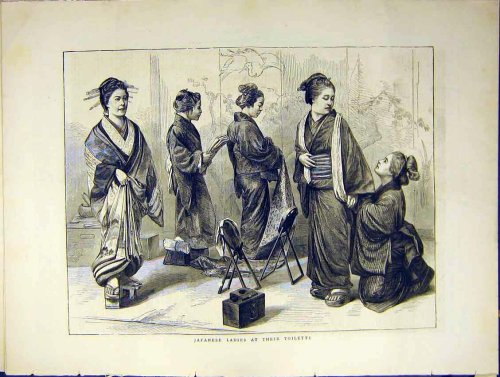
When western allied troops made their way to Japan, they discovered the zori and upon their return to America, brought some with them home as souvenirs, thus providing the seed of the flip flop. By the 1950s, the appropriated American version had caught on in the beach-bum cultures of Hawaii and California. Over the next several decades, the flip flop blanketed the United States, but retained its original composition: cheap, immune to water, sidekick to the bathing suit. In the 1990s, their popularity soared to new heights as the dot-com boom inspired millions of would-be suits to mix corporate ambition and practiced informality for the first time.
Around the turn of the millennium, shoe designers began to exploit the popularity of the world's most casual shoe. Leather replaced rubber, sparkly and/or metal embellishments appeared. Pretty soon, traditional strappy sandals had been co-opted by the thong flip flop, and a calamitous new hybrid was born – summer sandals featuring a toe plug, seemingly as an aesthetic choice. That aesthetic was, to put it kindly, awkward:
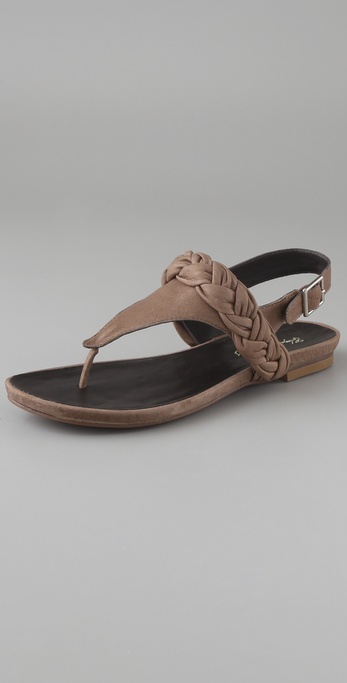
They almost invariably featured strange designs in which all lines led to that arbitrary point between the big toe and its neighbor. Except sometimes, when a perfectly normal sandal was accented by a single loop around the big toe; the toe plug as toe ring:

These developments were bad, but it was about to get worse. Like when Alice drank that magic potion and shot skyward in height, heels grew out of thong sandals and pushed them ever upward. And now, today, you can spend $400 on this pair of Jimmy Choos that brings honest-to-goodness tears of disillusionment to my eyes.
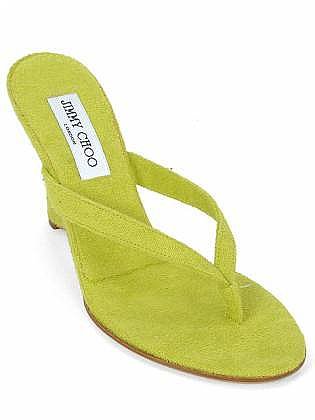
Thong flip flops are now the opposite of what they once were: cheap and easy. They're now onerous and fussy. I enter a shoe store and immediately dismiss 80 percent of the summer shoes on offer. The toe plug has infested the selection.
Thanks a lot, Japan. Thanks, allied troops. Thanks, surfers and shoe designers. Thanks, all you millions of people who should know better. Thanks a bunch. Flop.
* Name has been changed to protect the identity of my boyfriend.
Subscribe to:
Posts (Atom)