
I did a spot survey on the Q train platform this morning, and can safely estimate that at least 80 percent of women chose to wear some form of thong flip flop today, defying both good sense and good taste.
 They also defy the typical logic of shoe-wearing for women, which normally goes something like this: These shoes hurt, but they are gorgeous. Therefore, I will wear them (The Carrie Bradshaw logic). Or: These shoes are so comfortable, it doesn't matter that they aren't gorgeous. Therefore, I will wear them (The I'm a Mom logic). Or: These flats are both flattering and comfortable, and I am already tall enough. Therefore, I will wear them (The Brooklyn Girl logic).
Thong flip flops, however, follow no discernible logic: These shoes are ugly and uncomfortable and they are bad for my body. Therefore, I will wear them.

Most people, when confronted with the notion that thong flip flops are inherently uncomfortable, acknowledge they took some getting used to. “You just have to get accustomed to them, then they're fine,” explains S Jam Fitzgerald.* A friend proffers, “Every spring for the first couple of days, they bug me, but then I'm good for the summer.” They are speaking primarily of the “toe plug,” of course, that insane stretch of material that nestles between two of the toes and keeps the foot from leaving the enterprise behind altogether. There's nothing that feels natural about the toe plug – it's a toe plug! Still, people break themselves into them. But why? You can get accustomed to sweatshop labor or life without air conditioning, too, but that doesn't mean you want to pay $89.99 for the honor at Nine West.
But okay, if you are on the beach and want to wade into the surf, I get it. The old-school flips flops won't fall off, they won't be ruined by the water or the salt. They work. I'm not saying they work better than my summer go-to shoe of choice, the black Teva Kena, which seems to have possibly been tragically discontinued, but okay. And I'm not ignoring the fact that scientists have found that flips flops probably actually alter the way we walk in really bad ways , but okay.
We can thank World War II for providing the cultural cross-pollination that brought the flip flop to the United States. The Japanese have been wearing their version of the thong flip flop, the zori, for centuries. For them, however, it was always a formal shoe, when worn by women accompanied always by a movement-stultifying kimono, something akin to a floor-length mermaid dress and five-inch heels at the Oscars – the kind of outfit that rich people wear to show how unnecessary it is for them to move in ways which might earn a paycheck. The Japanese had that skill perfected long before we did.
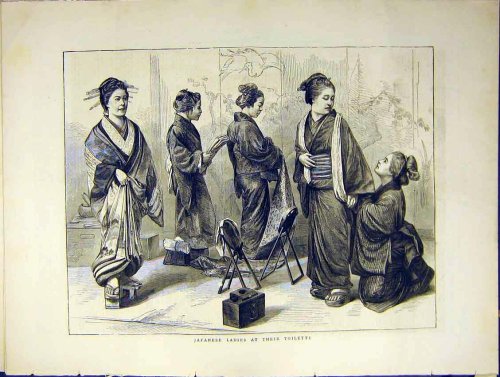
When western allied troops made their way to Japan, they discovered the zori and upon their return to America, brought some with them home as souvenirs, thus providing the seed of the flip flop. By the 1950s, the appropriated American version had caught on in the beach-bum cultures of Hawaii and California. Over the next several decades, the flip flop blanketed the United States, but retained its original composition: cheap, immune to water, sidekick to the bathing suit. In the 1990s, their popularity soared to new heights as the dot-com boom inspired millions of would-be suits to mix corporate ambition and practiced informality for the first time.
Around the turn of the millennium, shoe designers began to exploit the popularity of the world's most casual shoe. Leather replaced rubber, sparkly and/or metal embellishments appeared. Pretty soon, traditional strappy sandals had been co-opted by the thong flip flop, and a calamitous new hybrid was born – summer sandals featuring a toe plug, seemingly as an aesthetic choice. That aesthetic was, to put it kindly, awkward:
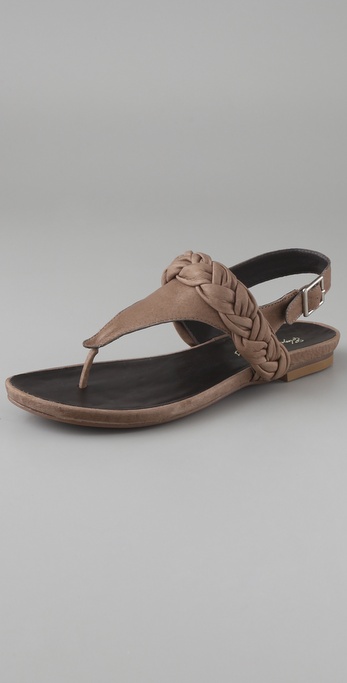
They almost invariably featured strange designs in which all lines led to that arbitrary point between the big toe and its neighbor. Except sometimes, when a perfectly normal sandal was accented by a single loop around the big toe; the toe plug as toe ring:

These developments were bad, but it was about to get worse. Like when Alice drank that magic potion and shot skyward in height, heels grew out of thong sandals and pushed them ever upward. And now, today, you can spend $400 on this pair of Jimmy Choos that brings honest-to-goodness tears of disillusionment to my eyes.
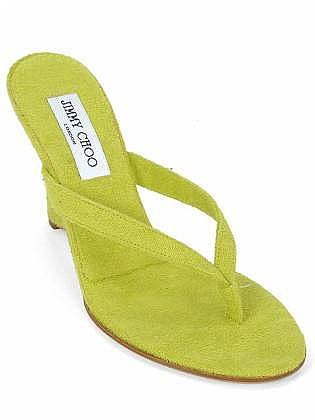
Thong flip flops are now the opposite of what they once were: cheap and easy. They're now onerous and fussy. I enter a shoe store and immediately dismiss 80 percent of the summer shoes on offer. The toe plug has infested the selection.
Thanks a lot, Japan. Thanks, allied troops. Thanks, surfers and shoe designers. Thanks, all you millions of people who should know better. Thanks a bunch. Flop.
* Name has been changed to protect the identity of my boyfriend.

No comments:
Post a Comment