Friday, May 20, 2011

A Fish Called Sushi

This fish, in what he can only hope is not a cruel joke at the hands of Destiny, is named Sushi. In this photo, we have Sushi offering up to his owner, Erum, who just hours later will depart for a summer in Berlin, his best puppy-dog face. I think it kind of works for him.

Still, he watched sadly and helplessly as she walked out the door at 6:30 a.m. en route to JFK, and grasped for the first time what it is to feel happy and sad at the same time.

Sushi would shed a tear, if saltwater weren't so violently lethal to him, a mere goldfish that isn't even gold. Sushi will persevere, left behind in his tank, pacing or circling until fall arrives and returns Erum to him. Or you know, since he's a goldfish, maybe he won't.

Wednesday, May 18, 2011

Epitaph of a Small Winner, The Best Book You've Never Heard Of

That weasel Woody Allen – the piddlingest man ever to become a lady-killer – included Epitaph of a Small Winner on his list of five favorite all time books over at The Daily Beast, and I once again find myself applauding his artistic sensibilities in spite of his diminutive, incestuous, over-the-top Jewish neurotic tendencies (which explains the lady-killing, really). Epitaph of a Small Winner should be on more top five lists. It's on mine. And Susan Sontag wrote an ecstatic introduction to the English translation, so now you don't even have to take my and Woody's word for it.

Written by the 19th century Brazilian author Machado de Assis, the novel pops up from time to time in the general literary consciousness, enough to remain in print but hardly enough to be considered even a cult favorite.

I discovered it in much the same way as Allen – he stumbled upon it in his mailbox, I stumbled upon it in a used bookstore. Who knows what prompted me to buy it. I don't usually buy books that I have never ever heard of. It was probably the Sontag stamp of approval, if I'm being honest.

Unfortunately, Woody doesn't have much of use to say about the novel – “It's a very, very original piece of work.” Well, yes. It's also heartbreaking and cavalier at the same time, which most of my favorite things are and which I think is a real feat. Sontag summarizes the sentiment like this: “Epitaph of a Small Winner is probably one of those thrillingly original, radically skeptical books which will always impress readers with the force of a private discovery.”

By the way, it isn't really called Epitaph of a Small Winner. The direct translation is more like Posthumous Diaries of Braz Cubas. But I like Epitaph of a Small Winner better – in this case, the faulty outshines the precise. Like champagne! Sontag calls the English title “interfering,” but I still like it. It's okay to disagree with Susan Sontag! Champagne!

Monday, May 9, 2011

The Fact of Joan Didion's Fiction

Despite my longstanding, tenuously controlled obsession with Joan Didion, from which such things have been extracted as a passing interest in Los Angeles, photocopied essays thrust into the hands of unwitting acquaintances, and the title of this blog (callout to the only person who ever got the reference on his own), I never read any of her fiction until this past week, when I fluttered through Play It as It Lays.

It's a slight novel, about a woman for whom circumstance has made an impending nervous breakdown a credible option. She's married to a film producer, who took her from modeling in New York to occasional acting, but mostly lingering, in LA. It reminds me of the first pages of Fitzgerald's This Side of Paradise, where this happens:

From his fourth to his tenth year he did the country with his mother in her father’s private car, from Coronado, where his mother became so bored that she had a nervous breakdown in a fashionable hotel, down to Mexico City, where she took a mild, almost epidemic consumption.


At first, I was sure that the protagonist, Maria, was merely a standin for Didion herself, a woman who has maintained a decades-long, cerebrally antagonistic relationship with just, life. But by the final chapters, I knew she was writing about another kind of person, because when Didion writes about her own nervous breakdowns, they have historial weight to them – place and time matter, a lot – but Maria is simply adrift in a superficial milieu that she doesn't much consider, despite what the summary on the back cover says.

In my favorite Didion essays, like, for instance, “In the Islands,” she writes about places like the Royal Hawaiian Hotel via her own experience there, but also via the role it has played in society – the people that stayed there had lives “lived always on the streets where the largest trees grow.” (One of my all-time favorite Didionisms.) This class of people exist outside of the thrust and pull of the world's great events, enabled by their wealth, etc. This part of the essay is at least as important as Didion's first-person recollections, and it's the part that was missing from Play It as It Lays. And that's why, I'm fairly certain, she's a famous essayist more than a famous novelist.

Still, it's undeniably Joan Didion; the prose still makes one shake her head in awe and, along with those black-and-white photos of a small, glamorous, disaffected woman, wish for the 1000th time that she could be her.


Dog-eared passages:
From my mother I inherited my looks and a tendency to migraine. From my father I inherited an optimism which did not leave me until recently. -p.5

It came to her that in the scenario of her life this would be what was called an obligatory scene. -p.50

She pretended to herself that she was keeping the baby, the better to invite disappointment, court miscarriage. -p.63

Maria could never keep up her end of the dialogue with hairdressers. -p.120

Maria made a list of things she would never do. She would never: walk through the Sands or Caesar's alone after midnight. She would never: ball at a party, do S-M unless she wanted to, borrow furs from Abe Lipsey, deal. She would never: carry a Yorkshire in Beverly Hills. -p.136

Sunday, May 8, 2011

A Fur Coat or Some Animal ... Myself or Someone Else?


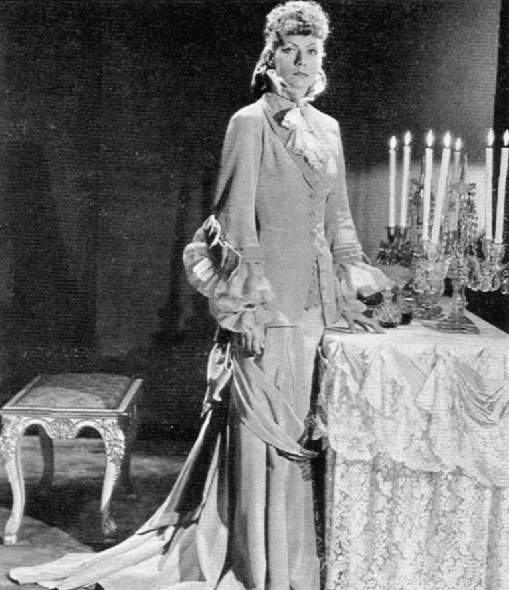
She kept having moments of doubt whether the carriage was moving forwards or backwards, or standing still. Was that Annushka beside her, or some stranger? ‘What is that on the armrest – a fur coat or some animal? And what am I? Myself or someone else?'
-Anna Karenina

Photo: Greta Garbo in the movie version, 1939

Wednesday, May 4, 2011

This Should Happen: Acting Awards for FNL's Vince

Michael B. Jordan, who plays star quarterback Vince on Friday Night Lights, deserves an Emmy/Golden Globe/Screen Actors Guild Award for his performance. Here's his Oscar-bait-money-clip from last week's episode, wherein he doesn't even talk until two minutes in and still manages to steal the scene:


He's just as good in the lighter moments, but I can't find a decent clip.

Friday, April 29, 2011

The People's Painting


Enlace, 2010
Painting bySpanish artist Juan Genoves.

Available at New York's Marlborough Gallery.

Tuesday, April 26, 2011

4 Thoughts I Directed at the TV Last Night

-There are Lost characters on every channel right now. This would have made a better ultimate plotline than that show's offensive finale. To wit (Hawaii 5-0, House, Modern Family, Mr. Sunshine):

-People never do tire of crime procedurals.

-Where's K-Fed?

-Every dress that T-mobile girl wears is amazing, and I don't even like pink. That somehow makes this an intelligent ad campaign:

Monday, April 25, 2011

New Madonna Book, Courtesy of Lots of People Including Me


An essay I wrote about Madonna's relationship with New York City will be included in the book, Madonna and Me, forthcoming from Soft Skull Press next year.

More news on this super exciting event as it super excitingly develops.

Saturday, April 23, 2011

Not Quite a Believer

Zoe Heller's The Believers, published two years ago to general critical acclaim, handles, one character at a time, the unraveling of the insufferable Litvinof family – a privileged clan of supposedly radical leftists luxuriously ensconced in a Greenwich Village townhouse.

The characters subject us to various intensities of annoyance. At the top of the heap in this regard is the clan's mother and the novel's central protagonist, Audrey.

Audrey is the least tolerable kind of leftist: theoretically in a fight for “the people” while simultaneously preoccupied with her own greatness – the cleaner does not show her enough deference, in her opinion; she daydreams of her husband's luxurious, star-studded funeral; she pretends money means nothing to her but resents those who have more. There is nothing to like about Audrey. She's mean to her daughters, she's borderline cruel to her best friend. Worse, the reader is left ignorant about why she's so unlikeable until page 190 (this excerpt is long, but necessarily so):

Once upon a time, her brash manner had been a mere posture – a convenient and amusing way for an insecure teenage bride, newly arrived in America, to disguise her crippling shyness. People had actually enjoyed her vituperation back then …

But somewhere along the way, when she hadn't been paying attention, her temper had ceased to be a beguiling party act that could be switched on and off at will. It had begun to express authentic resentments: boredom with motherhood, fury at her husband's philandering, despair at the pettiness of her domestic fate. She hadn't noticed the change at first. Like an old lady who persists in wearing the Jungle Red lipstick of her glory days, she had gone on for a long time, fondly believing that the stratagems of her youth were just as appealing as they'd every been. By the time she woke up and discovered that people had taken to making faces at her behind her back – that she was no longer a sexy young woman with a charmingly short fuse but middle-aged termagant – it was too late. Her anger had become a part of her.


It's a good passage. Unfortunately, it's the only one in the book your really need to read on the topic of Audrey. You've now got Audrey nailed.


And even given this explanation, Audrey's character remains unjustifiably rude, mean-spirited, curmudgeonly. You don't want to read a book about a person like this (or at least I didn't), you want to put her in her place, show her how entirely useless she is by ignoring her, which you can't do if you keep reading. It's hard to get into a book when really you just wish the protagonist would go away.

I realize that this begs a certain question about whether characters have to be likable in order for a book to be good. And obviously, the answer is no. Despicable protagonists in great novels abound: Humbert Humbert (Lolita), John Self (Money), Alexander Portnoy (Portnoy's Complaint). Even Jay Gatsby is not exactly likable.

A literary device (or several) must exist, then, that takes an unlikable human and makes him or her compelling. The contenders:

Satire: Satire has always been a tenuous concept for me; when I think about it for too long, I stop understanding what it means or being able to know it when I see it. For reference's sake, satire is:

A literary composition, in verse or prose, in which human folly and vice are held up to scorn, derision, or ridicule.

Which seems oversimplistic to me. Satire, I think, is a portrayal of someone or someplace in a way that exposes its flaws. And the best satire exposes this by being true to human nature. But it has to be a well-rounded portrayal -- simply holding up human folly and vice to scorn, derision or ridicule is not enough. Many political analysts do that every day, but it ain't satire.

So if a portrayal of an unlikable person achieves satire, we applaud it because we are in cahoots with the author in exposing some ridiculous trait of the human condition, and therefore, we find the character not only tolerable but entertaining. The Believers was called satire by many a reviewer, but I'm not quite following that logic.

Show Don't Tell, Duh: If Heller had shown us the root of Audrey's sour temperament rather than told us outright in one self-contained passage, we might have been able to relate to it. We've all had a bad day, succumbed unjustifiably to a grotesque mood, taken it out on a stranger or on the person closest to us. This is Audrey's entire life, yes, but there is a trickle of her life in ours, and had her perspective been better laid out, we may have found ourselves more prone to view her life through it.

Empathy: Could it be that those authors listed above – Amis, Nabokov, etc. – had an ego-driven empathy for their characters, while Heller has no sympathy for this tyrant of a woman she has created? And empathy from an author is necessary to produce empathy in the reader? Heller remains detached from her characters throughout, which causes us to remain detached from them throughout. If we are to like unlikeable characters, we need to be brought a whole lot closer to them.


Anyway, I didn't dislike this book as much as the above review likely suggests. But I didn't actively like it either. Yes, this is a pretty basic third-grade level analysis (“I liked the part where ...”), but it explains where The Believers falls on the love-hate spectrum. Didn't dislike it enough to throw in the towel, but wasn't driven to plow through it either, and I think that has something to do with the points outlined above.

*Interior shot above is Uma Thurman's former dining room. That seemed relevant.

Friday, April 15, 2011

The Lonely Photobooth

"Several Photo Booth Interiors (2005)," by Naomi Leibowitz.

You kind of forget that photo booths continue to exist when you and four drunk friends are not piled into them.

Discovered via Ocular Octopus.

Wednesday, April 13, 2011

If It Sounds Like Writing...

Some people get so lucky as to meet their literary heroes, and if they are even luckier, that hero utters a single sentence that, taken to heart, can meaningfully and permanently inform one's writing process. It's flash-mentoring, and apparently it happens in real life to other people.

Todd Zuniga's newish blog showcases such advice. It's a panacea for all of those with writer's block, ennui, or an internet connection (or, all of us, at some point). A couple of my favorites:

If it sounds like writing, rewrite it.

S. Patrick was told by Elmore Leonard

The best writing happens in the twenty minutes you DON’T get up for a cup of coffee.

Andrew O. Dugas was told by Ron Carlson


I keep hoping to send Todd my own nugget of appropriated writerly wisdom one day soon. But I have never met my favorite authors (with one notable exception -- and she did not want to bestow advice, she wanted me to disappear).

And then I am reminded of what I like to think of as my charming tendency to not ever remember the good advice I get anyway.